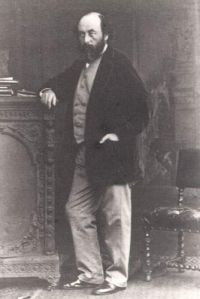
Joseph Beete Jukes

Joseph Beete Jukes

Summary

Portrait of Joseph Beete Jukes Joseph Beete Jukes The South Staffordshire Coalfield… (1859)

The Coal-measures of the South Welsh coal-field are certainly 7,000 feet, even if they are not in some places 12,000 feet, in aggregate thickness, and have a thick group of sandstone beds at the base, which may be called the Millstone Grit, as well as another higher up, known as Pennant Grit. But from underneath the Carboniferous Limestone, which forms the thick enamelled lining, as it were, of the basins of the South Welsh and Forest of Dean coal-fields, there rises on all sides a great group of red and brown sandstones and red marls, known as the Old Red Sandstone.
Source: Wikisource

Portrait of Joseph Beete Jukes Joseph Beete Jukes The South Staffordshire Coalfield… (1859)

Carboniferous limestone, and Old Red sandstone, between the Coal-measures and the Upper Silurian rocks of South Staffordshire.
If we proceed from the South Staffordshire to the North Staffordshire coal-field, a distance of only 20 or 25 miles, we find a vast difference in the constitution of the Carboniferous rocks. In South Staffordshire the Carboniferous rocks consist of Coal-measures only, the maximum thickness of which does not seem ever to have much exceeded 1,000 feet. In North Staffordshire these beds are far more numerous, and attain an aggregate thickness four or five times greater.
Source: Wikisource

Get perspective with Kwize: daily news enlightened by great literature