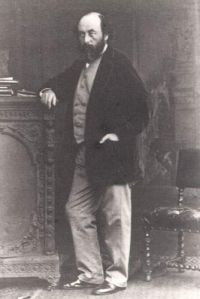
Joseph Beete Jukes

Joseph Beete Jukes

Summary

Portrait of Joseph Beete Jukes Joseph Beete Jukes The South Staffordshire Coalfield… (1859)

Changes in the grouping may occur either in the thickening or thinning of the measures between the coals, separating coals that were together, or bringing together those that were separate, or sometimes, but less frequently, even in the thickness of the coal-seams themselves, the very same becoming thicker in one place than another, or thinning out so as to occasionally disappear altogether. When, indeed, it becomes possible to trace a bed of coal over an indefinitely wide area, we must necessarily reach its termination by gradual thinning out in some direction or other.
Source: Wikisource

Portrait of Joseph Beete Jukes Joseph Beete Jukes The South Staffordshire Coalfield… (1859)

The South Staffordshire coal-field is distinguished from all others in the British Islands, and from most of those in the rest of the world, by the fact, that over a considerable part of its area a number of coals come together, resting one upon the other, with little or no interstratified shale or "parting" till they form a great seam of coal 30 feet in thickness.
Source: Wikisource

Portrait of Joseph Beete Jukes Joseph Beete Jukes The South Staffordshire Coalfield… (1859)

Grouping of the Measures.—The way in which the various beds of clay, shale, sandstone, coal, and ironstone are interstratified with each other, may be seen by reference to the four published sheets of Vertical Sections. Nos. 16, 17, 18, and 26. The Coal-measures of South Staffordshire, as of most other districts, are made up of a great series of alternating beds of these materials,— all of them varying in thickness and extent. As a general rule, the beds of coal are more constant in thickness, and extend over wider areas, than the beds of other materials.
Source: Wikisource

Get perspective with Kwize: daily news enlightened by great literature