Summary

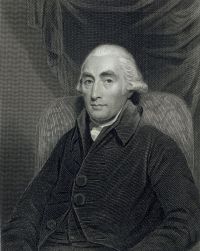
Portrait of Joseph Black Joseph Black Experiments upon magnesia alba…

Chemists have often observed, in their distillations, that part of a body has vanished from their senses, notwithstanding the utmost care to retain it; and they have always found, upon further inquiry, that subtile part to be air, which having been imprisoned in the body, under a solid form, was set free and rendered fluid and elastic by the fire. We may therefore safely conclude, that the volatile matter, lost in the calcination of magnesia, is mostly air; and hence the calcined magnesia does not emit air, or make an effervescence, when mixed with acids.
Source: Gutenberg

Portrait of Joseph Black Joseph Black Experiments upon magnesia alba…

II. If quick-lime be no other than a calcarious earth deprived of its air, and whose attraction for fixed air is stronger than that of alkalis, it follows, that, by adding to it a sufficient quantity of alkali saturated with air, the lime will recover the whole of its air, and be entirely restored to its original weight and condition: and it also follows, that the earth separated from lime-water by an alkali, is the lime which was dissolved in the water now restored to its original mild and insoluble state.
Source: Gutenberg

Portrait of Joseph Black Joseph Black Experiments upon magnesia alba…

Thus a calcarious earth that is pure or free of air has a much stronger attraction for acids than a pure volatile alkali, as is evident when we mix quick-lime with salt ammoniac; for the alkali is then immediately detached from the acid: and agreeably to this I found, upon trial, that a pure or caustic volatile alkali does not separate a calcarious earth from an acid. Yet, if we mix a mild volatile alkali, which is a compound of alkali and air, with a compound of acid and calcarious earth, these two last, which attract one another most strongly, do not remain united
Source: Gutenberg

Get perspective with Kwize: daily news enlightened by great literature