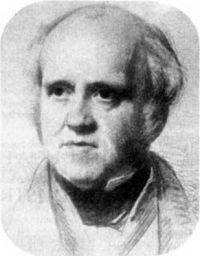
Leonard Horner

Leonard Horner

Summary

Portrait of Leonard Horner Leonard Horner On the Brine Springs at Droitwich (1814)

We learn, however, with tolerable certainty, that these springs are impregnated from a body of rock salt; and we obtain an additional testimony in support of the observation, that rock salt is invariably accompanied by gypsum. From the rapidity with which the brine rises to the surface, it is evident that the source of these springs must be situated in much higher ground than that in which the pits are sunk.
Source: Wikisource

Portrait of Leonard Horner Leonard Horner On the Brine Springs at Droitwich (1814)

The prevailing rock around Droitwich is a fine-grained calcareo-argillaceous sandstone, of a brownish red colour, with occasional patches and spots which are greenish blue. At Doder Hill, where a vertical section of it is exposed, it contains beds of a greenish grey colour, and of a more indurated texture, but which do not appear to differ materially in composition from the red sandstone. These contain slender veins of crystallized gypsum, the forms of which are very distinct, where the widening of the vein has produced small cavities. I did not observe any gypsum in the red sandstone.
Source: Wikisource

Portrait of Leonard Horner Leonard Horner On the Brine Springs at Droitwich (1814)

In 1773 Joseph Priddey, of Droitwich, informed me that he had sunk several pits, and generally found it about 35 feet to the talc, through the stratum of talc 150 feet, under the talc a river of brine 22 inches deep, under this river a hard rock of salt. When the hole is bored through the talc, the brine bursts up with amazing violence to the surface of the ground.
Source: Wikisource

Get perspective with Kwize: daily news enlightened by great literature