Summary

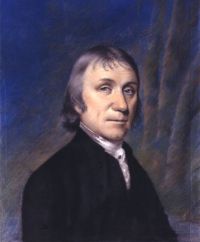
Portrait of Joseph Priestley Joseph Priestley Historical Account of the Navigable Rivers… (1831)

The Origin of Inland Navigation, like most other useful discoveries, is involved in great obscurity, and any attempt to ascertain the precise period of the invention or the name of him, who first pointed out the utility of these important adjuncts to the convenience and profit of commercial nations, would be merely to speculate on a subject, which has hitherto bid defiance to conjecture, and which will, in all human probability, for ever remain without satisfactory elucidation.
Source: Wikisource

Portrait of Joseph Priestley Joseph Priestley Historical Account of the Navigable Rivers… (1831)

The River Frome is but a small stream, which rising near the town of Wickwar, in Gloucestershire, passes Iron Acton, and, in its course by Stoke Gifford House, supplies a number of mills and manufactories. It enters on the north side of Bristol, and passing through the centre of the city, falls into the floating-dock, or ancient course of the Avon. The last half mile of its course is used as a dock and harbour, (no other portion being navigable,) and as it is in the very heart of the city, its value may be easily appreciated.
Source: Wikisource

Portrait of Joseph Priestley Joseph Priestley Historical Account of the Navigable Rivers… (1831)

In France the history of inland navigation may be traced backward for a long succession of years. The great canal of Burgundy, better known as the canal of Briare, commencing at that town in the River Loire, and passing on to Montargis, proceeds to a junction with the canal of Orleans, and falls into the Seine at Fontainbleau. This work was commenced under Henry the Fourth. The famous canal of Languedoc, forming a junction between the Ocean and the Mediterranean, was projected in the reign of Francis I. in 1661, and finished in fifteen years
Source: Wikisource

Get perspective with Kwize: daily news enlightened by great literature