Summary

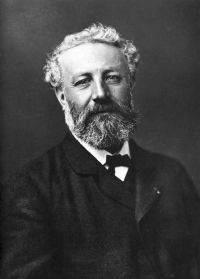
Portrait of Jules Verne Jules Verne,  Claudius Bombarnac — Chapter IV

“ The paddles are impetuously beating into the sea, and now and then breaking into thunder, as one or the other of the wheels runs wild, as the rolling lifts it clear of the water. A thick smoke rises from the funnel, which occasionally belches forth a shower of sparks.
At nine o'clock the night is very dark. I try to make out some steamer's lights in the distance, but in vain, for the Caspian has not many ships on it. I can hear only the cry of the sea birds, gulls and scoters, who are abandoning themselves to the caprices of the wind.
”
Source: Wikisource

Portrait of Jules Verne Jules Verne,  Claudius Bombarnac — Chapter IV

“ The clouds in the zenith are the first to color. The sun appears at last all watery with the mists of the sea.
I look; it is indeed the case addressed to Pekin. I notice that certain holes are pierced here and there, by which the air inside can be renewed. Perhaps two eyes are looking through these holes, watching what is going on outside? Do not be indiscreet!
At breakfast gather all the passengers whom the sea has not affected: the young Chinaman, Major Noltitz, Ephrinell, Miss Bluett, Monsieur Caterna, the Baron Weissschnitzerdörfer, and seven or eight other passengers.
”
Source: Wikisource

Portrait of Jules Verne Jules Verne,  Claudius Bombarnac — Chapter IV

“ True, the Caspian is only a lake about eighty feet below the level of the Mediterranean, but this lake is often troubled by violent storms. A ship cannot "get away," as sailors say: it is only about a hundred leagues wide. The coast is quickly reached eastward or westward, and harbors of refuge are not numerous on either the Asiatic or the European side.
There are a hundred passengers on board the Astara—a large number of them Caucasians trading with Turkestan, and who will be with us all the way to the eastern provinces of the Celestial Empire.
”
Source: Wikisource

Get perspective with Kwize: daily news enlightened by great literature