“ It is better for us to see the goal we want to reach than the place we started from.""You are right, Barbicane," answered Captain Nicholl; "and besides, when we have reached the moon we shall have plenty of time during the long lunar nights to consider at leisure the globe that harbours men like us.""Men like us!" cried Michel Ardan. "But now they are not more like us than the Selenites. We are inhabitants of a new world peopled by us alone—the projectile! I am a man like Barbicane, and Barbicane is a man like Nicholl. ”
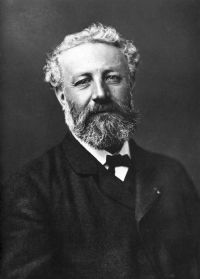
Jules Verne
Summary
Jules Verne’s From the Earth to the Moon is a science fiction novel that recounts the daring journey of three travelers—Michel Ardan, Barbicane, and Captain Nicholl—launched by a massive cannon toward the Moon. Set against the backdrop of 19th-century scientific ambition, the narrative examines themes of ballistics, lunar exploration, and the rivalries within the Gun Club, merging technical speculation with human enterprise.
Through discussions on gravity, space travel, and the Moon’s enigmas, Verne combines adventure with scientific precision, portraying the journey as both a tribute to human creativity and a reflection on the mysteries of the cosmos.
Quotes from The Moon-Voyage (Jules Verne)
“ No more cranes, screw-jacks, windlasses, cranks, or other machines will be wanted.""Well said," replied Barbicane; "but if nothing had any weight nothing would keep in its place, not even the hat on your head, worthy Michel; nor your house, the stones of which only adhere by their weight! Not even ships, whose stability upon the water is only a consequence of weight. Not even the ocean, whose waves would no longer be held in equilibrium by terrestrial attraction. Lastly, not even the atmosphere, the molecules of which, being no longer held together, would disperse into space!" ”
“ We are on the road; there are no obstacles before us, and no stones on our route. It is free—freer than that of a ship that has to struggle with the sea, or a balloon with the wind against it! Now if a ship can go where it pleases, or a balloon ascend where it pleases, why should not our projectile reach the goal it was aimed at?""It will reach it," said Barbicane."If only to honour the American nation," added Michel Ardan, "the only nation capable of making such an enterprise succeed—the only one that could have produced a President Barbicane! ”
