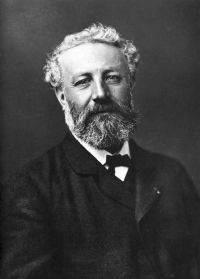
Jules Verne

Jules Verne

Summary

Portrait of Jules Verne Jules Verne From the Earth to the Moon (1865)

Man began by walking on all-fours; then, one fine day, on two feet; then in a carriage; then in a stage-coach; and lastly by railway. Well, the projectile is the vehicle of the future, and the planets themselves are nothing else! Now some of you, gentlemen, may imagine that the velocity we propose to impart to it is extravagant. It is nothing of the kind. All the stars exceed it in rapidity, and the earth herself is at this moment carrying us round the sun at three times as rapid a rate, and yet she is a mere lounger on the way compared with many others of the planets!
Source: Wikisource

Portrait of Jules Verne Jules Verne From the Earth to the Moon (1865)

To these insinuations Barbicane returned no answer; perhaps he never heard of them, so absorbed was he in the calculations for his great enterprise.
When his famous communication was made to the Gun Club, the captain's wrath passed all bounds; with his intense jealousy was mingled a feeling of absolute impotence. How was he to invent anything to beat this 900-feet Columbiad? What armor-plate could ever resist a projectile of 30,000 pounds weight? Overwhelmed at first under this violent shock, he by and by recovered himself, and resolved to crush the proposal by weight of his arguments.
Source: Wikisource

Portrait of Jules Verne Jules Verne From the Earth to the Moon (1865)

If Providence has created the stars and the planets, man has called the cannon-ball into existence. Let Providence claim the swiftness of electricity and of light, of the stars, the comets, and the planets, of wind and sound-- we claim to have invented the swiftness of the cannon-ball, a hundred times superior to that of the swiftest horses or railway train. How glorious will be the moment when, infinitely exceeding all hitherto attained velocities, we shall launch our new projectile with the rapidity of seven miles a second!
Source: Wikisource

Get perspective with Kwize: daily news enlightened by great literature