Summary

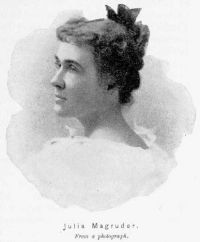
Portrait of Julia Magruder Julia Magruder Miss Ayr of Virginia & other stories

To look into Rose-Jewel’s great delighted eyes, across his violin, and to see them gleam and glow with an emotion that corresponded absolutely to his, was, he thought, as keen a pleasure as he, or mortal man beside had ever known.
In time it became a positive, thrilling, marvelous certainty that Rose-Jewel had a voice—a clear, true, strong little voice that gave magnificent promise. Then came the other delight, when she was older, of teaching her to strike little melodies on the piano, and even to put her baby fingers on certain simple chords, as an accompaniment to her father’s violin.
Source: Gutenberg

Portrait of Julia Magruder Julia Magruder Miss Ayr of Virginia & other stories

As he did so the baby smiled. It must be a hard heart that refuses to return the smile of a child, and Eastin’s heart was soft as wax to any sign of love. The baby smiled again, and this time the smile was accompanied by a repetition of the little gurgling laugh. Eastin’s face grew red, then pale, and he fell upon his knees beside the crib. A mighty impulse stirred his heart. It gave a great bound, as if it freed itself from cords that had held it in and from weights that had dragged it down. Words that leaped upward as if from its secret depths came in rapid whispers from his lips.
Source: Gutenberg

Portrait of Julia Magruder Julia Magruder Miss Ayr of Virginia & other stories

He wished that the child might have all the traits that he lacked, but he passionately wished, also, that it might have one thing that he possessed—this spirit of music, that was to him alternately a devil of despair and an angel of consolation. Surely, surely, if another being should possess an inward prompting such as his, something would come of it! Surely, no other creature who possessed it could be so handicapped by the impotent body and incapable mind, which he knew to be its accompaniment in him!
Source: Gutenberg

Get perspective with Kwize: daily news enlightened by great literature