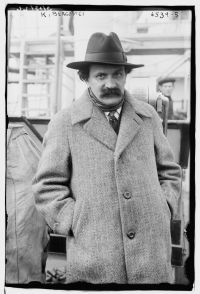
Konrad Bercovici

Konrad Bercovici

Summary

Portrait of Konrad Bercovici Konrad Bercovici Dust of New York

It was early spring; the time when life asserts itself; when dog and man howls to the moon and snaps at each falling star.
That dog Babeta had kicked out so violently from the restaurant came nightly under the window of his belle and called, begged, serenaded and pleaded in even more heartrending tones than the tenor in Bizet's "Pecheur des Perles." And it was Prosper again who brought the astonishing news "Ophelia was stolen!"
It was Babeta's version of what had happened. The lattices of the shutters were smashed, the window broken and the dog gone. Babeta was the most disconsolate of men.
Source: Gutenberg

Portrait of Konrad Bercovici Konrad Bercovici Dust of New York

Chords struck on a guitar, to accompany a subdued voice, high colors on the window curtains, a mixed odor of garlic, incense and heavy-scented perfumes, suggest something indefinably Moorish, Alhambresque; slow yet passionate, like cold fire.
And lo! the mirage vanishes! You are out of the district. The modest warm curve of the Orient has disappeared, the arrogant cold straight line of the Occident stares at you. You are in the heart of busy old New York.
Source: Gutenberg

Portrait of Konrad Bercovici Konrad Bercovici Dust of New York

Silvio Romano was terribly incensed. Several times he made up his mind to tell the youth they had reached the parting point. To dare sneer at Rossini! Rossini, the greatest master of them all—the god of music! let alone Donizetti—it was nothing less than sacrilege.
After those thoughts had had their sway, more practical ones presented themselves. Romano thought of the difficulty to find another man. Salvatore was such a good barber!
A hard battle between business and artistic ideals, indeed!
Source: Gutenberg

Get perspective with Kwize: daily news enlightened by great literature