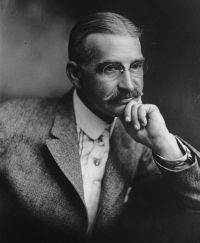
L. Frank Baum

L. Frank Baum

Summary

Portrait of L. Frank Baum L. Frank Baum American Fairy Tales

The following day he called upon Miss Mydas, who was reading a novel and eating chocolate creams as happily as if she had never been ill in her life.
“Where did you get the magic compound that cured me?” she asked.
“From a learned wizard,” said he; and then, thinking it would interest her, he told how he had made the glass dog for the wizard, and how it barked and kept everybody from bothering him.
“How delightful!” she said. “I’ve always wanted a glass dog that could bark.”
“But there is only one in the world,” he answered, “and it belongs to the wizard.”
Source: Gutenberg

Portrait of L. Frank Baum L. Frank Baum American Fairy Tales

Fashions often change among the earth people, who tire quickly of any one thing. When they read in their newspapers and magazines that the style is so-and-so, they never question the matter, but at once obey the mandate of fashion. So you must visit the newspapers and magazines and enchant the types.”
“Enchant the types!” echoed Popopo, in wonder.
“Just so. Make them read that it is no longer the fashion to wear birds upon hats. That will afford relief to your poor milliner and at the same time set free thousands of our darling birds who have been so cruelly used.”
Source: Gutenberg

Portrait of L. Frank Baum L. Frank Baum American Fairy Tales

And Keo ran. Swift as the wind he strode, away from the village, through the forest and straight up the river bank. The black men howled with fear; the Jolly One roared with laughter; and on, on, on they rushed!
Then before them, on the opposite side of the river, appeared the black mouth of Glinkomok’s cave. Keo dashed into the water, dived to the bottom and left the black people struggling to swim out. But Glinkomok had heard the laughter of Keo and knew what to do. When the Jolly One rose to the surface and blew the water from his throat there was no black man to be seen.
Source: Gutenberg

Get perspective with Kwize: daily news enlightened by great literature