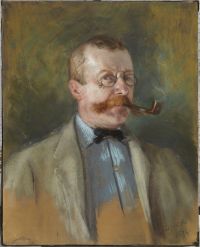
Laurence Hutton

Laurence Hutton

Summary

Portrait of Laurence Hutton Laurence Hutton Literary Landmarks of Oxford (1903)

Oxford is very rich in guide-books, from a sixpence up; and very, very rich in Literary Landmarks, from Roger Bacon, Wycliffe, and Erasmus, down to the men of our own day. But those guide-books, while they tell one a great deal that one wants to know, in too many cases fail to tell one what certain ones want particularly to know, to wit: where Sidney roomed at Christ Church, what Beaumont and Shenstone did at Pembroke, how John Evelyn conducted himself at Oriel, as well as why some of these men left their colleges without their degrees, and how all of them passed their lives in Oxford
Source: Wikisource

Portrait of Laurence Hutton Laurence Hutton Literary Landmarks of Oxford (1903)

But, to the trans-Atlantic visitor to Oxford, somehow, the "glories" of High Street are the streets and lanes that lead out of it: Oriel Street, Logic Lane, The Turl, and the rest of them, queer and delightful themselves and leading, always, to something delightful and queer. Every one of these streets has been trod, and trod again, by the present Landmarker, hat in hand in his reverence for the memories of the men who have trod them in days gone by.
Source: Wikisource

Portrait of Laurence Hutton Laurence Hutton Literary Landmarks of Oxford (1903)

Only Dr. Johnson! And we do so gallant about! You can imagine with what delight he showed me every part of his own College [Pembroke] . After dinner Johnson begged to conduct me to see the College; he would let no one show it me but himself. 'This was my room, this Shenstone's.' Then, after pointing out all the rooms of the poets who had been at this College, 'In short,' he said, 'we were a nest of singing birds!'"
It is an unfailing pleasure to "gallant" about Oxford, with any party, or absolutely alone; but with Johnson and Hannah More it must have been delightful indeed.
Source: Wikisource

Get perspective with Kwize: daily news enlightened by great literature