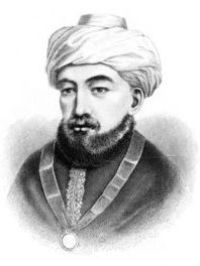
Maimonides

Maimonides

Summary

Portrait of Maimonides Maimonides,  The Guide for the Perplexed (1904)

“ You must know that if a person, who has attained a certain degree of perfection, wishes to impart to others, either orally or in writing, any portion of the knowledge which he has acquired of these subjects, he is utterly unable to be as systematic and explicit as he could be in a science of which the method is well known. The same difficulties which he encountered when investigating the subject for himself will attend him when endeavouring to instruct others; viz., at one time the explanation will appear lucid, at another time, obscure; ”
Source: Wikisource

Portrait of Maimonides Maimonides,  The Guide for the Perplexed (1904)

“ He who desires to be just must not show himself hostile to his opponent; he must have sympathy with him, and readily acknowledge any truth contained in his words; he must admit the correctness of such of his opponent's arguments as he would admit if they were in his own favour!' This is the contents of the words of Aristotle. Now, I ask you, men of intelligence, can we have any complaint against him after this frank statement? Or can any one now imagine that a real proof has been given for the Eternity of the Universe? ”
Source: Wikisource

Portrait of Maimonides Maimonides,  The Guide for the Perplexed (1904)

“ Thus for man death is evil: death is his non-existence. Illness, poverty, and ignorance are evils for man: all these are privations of properties. If you examine all single cases to which this general proposition applies, you will find that there is not one case in which the proposition is wrong except in the opinion of those who do not make any distinction between negative and positive properties, or between two opposites, or do not know the nature of things,--who, e.g., do not know that health in general denotes a certain equilibrium, and is a relative term. ”
Source: Wikisource

Get perspective with Kwize: daily news enlightened by great literature