Summary

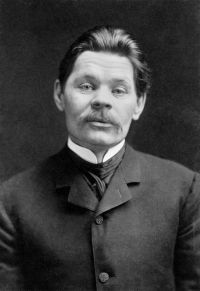
Portrait of Maksim Gorky Maksim Gorky,  Creatures That Once Were Men

“ Gavrilo swung the oars.
The boat moved with rapid, irregular jerks, noisily cutting the water.
"Steady!"
Chelkash got up from the stern, still holding the oars in his hands, and
peering with his cold eyes into the pale and twitching face of Gavrilo.
Crouching forward Chelkash was like a cat on the point of springing.
There was the sound of angry gnashing of teeth.
"Who's calling?" rang out a surly shout from the sea.
"Now, you devil, row! quietly with the oars! I'll kill you, you cur. Come, row! One, two! There! you only make a sound! I'll cut your throat!" hissed Chelkash.
”
Source: Gutenberg

Portrait of Maksim Gorky Maksim Gorky,  Creatures That Once Were Men

“ A man's got to have teeth and claws in this world!
They'll all have a go at you. Can you stick up for yourself?
How would you set about it? Damn it all; where the devil
could you go?"
"I," said Mitia, suddenly arousing herself; "I shall go away.
I shall go in the autumn to the Caucasian Mountains, and that will be
the end of it all. My God! If only I could get away from you all!
Soulless, godless men! To get away from you, that's my only hope!
What do you live for? Where is your God? He's nothing but a name!
Do you live in Christ? You are wolves; that's what you are!
”
Source: Gutenberg

Portrait of Maksim Gorky Maksim Gorky,  Creatures That Once Were Men

“ When you die you have only God to deal with . . . but here you have to deal with men . . . and men— what are they?"
"Enough! . . . Be quiet!" interrupted Kuvalda angrily.
And in the dawn, which filled the dosshouse, a solemn stillness reigned over all. Long and silently they sat at the feet of their dead companion, seldom looking at him, and both plunged in thought. Then Tyapa asked:
"Will you bury him?"
"I? No, let the police bury him!"
"You took money from Vaviloff for this petition . . . and I will give you some if you have not enough."
”
Source: Gutenberg

Get perspective with Kwize: daily news enlightened by great literature