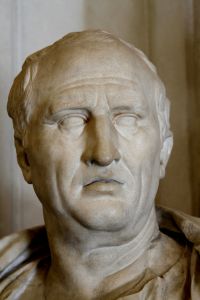
Marcus Tullius Cicero

Marcus Tullius Cicero

Summary

Portrait of Marcus Tullius Cicero Marcus Tullius Cicero Cicero de Senectute (on old age… (1884)

Cicero's faith transcended, and in great part created, his reasons for it, and it failed him in the very crises in which he most needed it; St. Paul "knew in whom he had believed," and his faith was sightlike when death seemed nearest. It is of no little worth to us that Socrates and Plato, Cicero and Plutarch, felt so intensely the pulse-beat of the undying life within. Of inestimably greater evidential value is it, that he whose peerless beauty of holiness made his humanity divine ever spoke of the eternal life as the one reality of human being.
Source: Wikisource

Portrait of Marcus Tullius Cicero Marcus Tullius Cicero Cicero de Senectute (on old age… (1884)

In the outward universe there is an infinity of beauty and of loveliness. The Creator englobes his own attributes in all his works. What we get from them is finite, solely because the taste and feeling that apprehend them are finite. But our receptivity grows with the growth of character, and our revenue of delight from field and garden, orchard and forest, brook and stream, sunset clouds and star-gemmed skies, is in full proportion to our receptivity, and is never so rich and so gladdening as in the later years of life. Cicero evidently felt this.
Source: Wikisource

Portrait of Marcus Tullius Cicero Marcus Tullius Cicero Cicero de Senectute (on old age… (1884)

Meanwhile, it is well for mankind that old men are so few. Were they more numerous, and at the same time worthy to retain the confidence of their fellow-men, the young would lack the exercise and discipline of their powers which alone could fit them for an honorable and useful old age. Death oils all the wheels of life. It is always throwing heavy responsibility on those who do not seek it, but accept it as a necessity, and gird themselves to bear it faithfully and nobly.
Source: Wikisource

Get perspective with Kwize: daily news enlightened by great literature