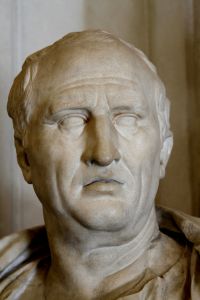
Marcus Tullius Cicero

Marcus Tullius Cicero

Summary

Portrait of Marcus Tullius Cicero Marcus Tullius Cicero Cicero de Senectute (on old age… (1884)

Indeed, were any god to grant that from my present age I might go back to boyhood, or become a crying child in the cradle, I should steadfastly refuse; nor would I be willing, as from a finished race, to be summoned back from the goal to the starting-point. For what advantage is there in life? Or rather, what is there of arduous toil that is wanting to it? But grant all that you may in its favor, it still certainly has either its excess or its fit measure of duration. I am not, indeed, inclined to speak ill of life, as many and even wise men have often done, nor am I sorry to have lived
Source: Wikisource

Portrait of Marcus Tullius Cicero Marcus Tullius Cicero Cicero de Senectute (on old age… (1884)

Or think you,—if after the manner of old men I may boast a little on my own account,—think you that I would have taken upon myself such a vast amount of labor, by day and by night, at home and in military service, if I had been going to put the same limits to my fame that belong to my earthly life? Would it not have been much better to pass my time in leisure and quiet, remote from toil and strife? But somehow my soul, raising itself [101] above the present, was always looking onward to posterity, as if, when it departed from life, then at length it would truly live.
Source: Wikisource

Portrait of Marcus Tullius Cicero Marcus Tullius Cicero Cicero de Senectute (on old age… (1884)

Old age, fearless of death, may transcend youth in courage and in fortitude. Such is the meaning of Solon's answer to the tyrant Pisistratus, who asked him what was his ground of confidence in resisting him so boldly, and Solon replied, "Old age." But the most desirable end of life is when—the understanding and the other faculties unimpaired—Nature, who put together, takes apart her own work. As he who built a ship or a house can take it to pieces the most easily, so Nature, who compacted the human frame, is the best agent for its dissolution.
Source: Wikisource

Get perspective with Kwize: daily news enlightened by great literature