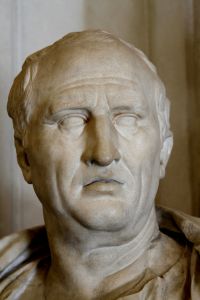
Marcus Tullius Cicero

Marcus Tullius Cicero

Summary

Portrait of Marcus Tullius Cicero Marcus Tullius Cicero De Amicitia, Scipio's Dream

For, by the faith of gods and men, who is there that would be willing to have a superabundance of all objects of desire and to live in the utmost fulness of wealth and what wealth can bring, on condition of neither loving any one nor being loved by any one? This, indeed, is the life of tyrants, in which there is no good faith, no affection, no fixed confidence in kindly feeling, perpetual suspicion and anxiety, and no room for friendship; for who can love either him whom he fears, or him by whom he thinks that he is feared?
Source: Gutenberg

Portrait of Marcus Tullius Cicero Marcus Tullius Cicero De Amicitia, Scipio's Dream

Virtue, I say to you, Caius Fannius, and to you, Quintus Mucius,—virtue both forms and preserves friendships. In it is mutual agreement; in it is stability; in it is consistency of conduct and character. When it has put itself forth and shown its light, and has seen and recognized the same light in another, it draws near to that light, and receives in return what the other has to give; and from this intercourse love, or friendship,—call it which you may,—is kindled.
Source: Gutenberg

Portrait of Marcus Tullius Cicero Marcus Tullius Cicero De Amicitia, Scipio's Dream

But if good faith has such attractive power that we love it in those whom we have never seen, or—what means still more—in an enemy, what wonder is it if the minds of men are moved to affection when they behold the virtue and goodness of those with whom they can become intimately united?
Love is, indeed, strengthened by favors received, by witnessing assiduity in one's service, and by habitual intercourse; and when these are added to the first impulse of the mind toward love, there flames forth a marvellously rich glow of affectionate feeling.
Source: Gutenberg

Get perspective with Kwize: daily news enlightened by great literature