Summary

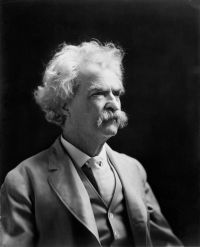
Portrait of Mark Twain Mark Twain Fenimore Cooper's Literary Offences

Pathfinder waited an impressive moment or two; then said, in that calm, indifferent, know-it-all way of his, “No, Major, he has covered Jasper's bullet, as will be seen if any one will take the trouble to examine the target.”
Wasn't it remarkable! How could he see that little pellet fly through the air and enter that distant bullet-hole? Yet that is what he did; for nothing is impossible to a Cooper person. Did any of those people have any deep-seated doubts about this thing? No; for that would imply sanity, and these were all Cooper people.
Source: Gutenberg

Portrait of Mark Twain Mark Twain Fenimore Cooper's Literary Offences (1895)

He knew -- doubtless saw -- at the distance of a hundred yards -- this his bullet had passed into the hole without fraying the edges. There were now three bullets in that one hole -- three bullets embedded processionally in the body of the stump back of the target. Everybody knew this -- somehow or other -- and yet nobody had dug any of them out to make sure. Cooper is not a close observer, but he is interesting. He is certainly always that, no matter what happens. And he is more interesting when he is not noticing what he is about than when he is.
Source: Wikisource

Portrait of Mark Twain Mark Twain Fenimore Cooper's Literary Offences (1895)

For several years, Cooper was daily in the society of artillery, and he ought to have noticed that when a cannon-ball strikes the ground it either buries itself or skips a hundred feet or so; skips again a hundred feet or so -- and so on, till finally it gets tired and rolls. Now in one place he loses some "females" -- as he always calls women -- in the edge of a wood near a plain at night in a fog, on purpose to give Bumppo a chance to show off the delicate art of the forest before the reader. These mislaid people are hunting for a fort.
Source: Wikisource

Get perspective with Kwize: daily news enlightened by great literature