Summary

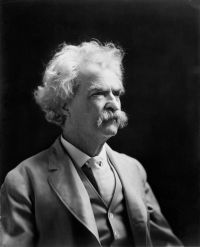
Portrait of Mark Twain Mark Twain Following the Equator: A Journey Around the World…

A very light straw color is their commonest tint. It seemed to me that these uncut gems must be more beautiful than any cut ones could be; but when a collection of cut ones was brought out, I saw my mistake. Nothing is so beautiful as a rose diamond with the light playing through it, except that uncostly thing which is just like it—wavy sea-water with the sunlight playing through it and striking a white-sand bottom.
Source: Gutenberg

Portrait of Mark Twain Mark Twain Following the Equator: A Journey Around the World…

Before the middle of July we reached Cape Town, and the end of our African journeyings. And well satisfied; for, towering above us was Table Mountain—a reminder that we had now seen each and all of the great features of South Africa except Mr. Cecil Rhodes. I realize that that is a large exception. I know quite well that whether Mr. Rhodes is the lofty and worshipful patriot and statesman that multitudes believe him to be, or Satan come again, as the rest of the world account him, he is still the most imposing figure in the British empire outside of England.
Source: Gutenberg

Portrait of Mark Twain Mark Twain Following the Equator: A Journey Around the World…

This is slavery, and is several times worse than was the American slavery which used to pain England so much; for when this Rhodesian slave is sick, super-annuated, or otherwise disabled, he must support himself or starve—his master is under no obligation to support him.
The reduction of the population by Rhodesian methods to the desired limit is a return to the old-time slow-misery and lingering-death system of a discredited time and a crude "civilization." We humanely reduce an overplus of dogs by swift chloroform; the Boer humanely reduced an overplus of blacks by swift suffocation
Source: Gutenberg

Get perspective with Kwize: daily news enlightened by great literature