Summary

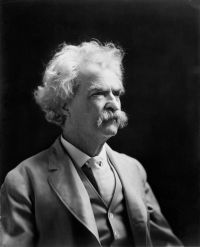
Portrait of Mark Twain Mark Twain The Innocents Abroad — Chapter XLV. (1869)

The balance of the population are asleep within doors, or abroad tending goats in the plains and on the hill-sides. The village is built on some consumptive little water-course, and about it is a little fresh-looking vegetation. Beyond this charmed circle, for miles on every side, stretches a weary desert of sand and gravel, which produces a gray bunchy shrub like sage-brush. A Syrian village is the sorriest sight in the world, and its surroundings are eminently in keeping with it.
Source: Wikisource

Portrait of Mark Twain Mark Twain The Innocents Abroad — Chapter XLV. (1869)

My umbrella is with the baggage, and so are my green spectacles—and there they shall stay. I will not use them. I will show some respect for the eternal fitness of things. It will be bad enough to get sun-struck, without looking ridiculous into the bargain. If I fall, let me fall bearing about me the semblance of a Christian, at least.
Three or four hours out from Damascus we passed the spot where Saul was so abruptly converted, and from this place we looked back over the scorching desert, and had our last glimpse of beautiful Damascus, decked in its robes of shining green.
Source: Wikisource

Portrait of Mark Twain Mark Twain The Innocents Abroad — Chapter XLV. (1869)

The idea of riding all day long over such ghastly inquisitions of torture is sickening. My horse must be like the others, but I have at least the consolation of not knowing it to be so.
I hope that in future I may be spared any more sentimental praises of the Arab’s idolatry of his horse. In boyhood I longed to be an Arab of the desert and have a beautiful mare, and call her Selim or Benjamin or Mohammed, and feed her with my own hands, and let her come into the tent, and teach her to caress me and look fondly upon me with her great tender eyes
Source: Wikisource

Get perspective with Kwize: daily news enlightened by great literature