Summary

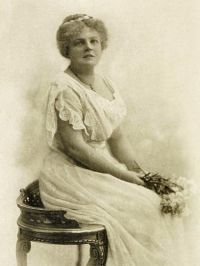
Portrait of Mary Gaunt Mary Gaunt Alone in West Africa

There is nothing to be seen but the brown, winding roadway, the dense green of the undergrowth, and the trunks of the trees tall and straight as Nelson's column and brown or white against the prevailing green. And there are all shades of green, from that so pale that it is almost golden to that so dark it is almost black, but never a flower breaks the monotony, the monotony that is not monotony but dignity, and the flowers of an English spring or an autumn in Australia would but cheapen the forest of the Gold Coast.
Source: Gutenberg

Portrait of Mary Gaunt Mary Gaunt Alone in West Africa

Fear hid on the verandah; I could hear him in the creak of a door, in the “pad, pad” of the slave-boy's feet; I could almost have sworn I saw him skulking under the mango tree where were kept the thermometers; and when on Easter Sunday a tornado swept down from the hills, blotting out the vivid green in one pall of grey mist, he was in the shrieking wind and in the shuddering rain.
Never was I more impersonally sorry to leave a man alone, for if I saw my host again I doubt if he would recognise me, but it seemed wicked to leave a fellow white man alone in such a place.
Source: Gutenberg

Portrait of Mary Gaunt Mary Gaunt Alone in West Africa

I looked out; there was the clearing round the house, the gloom of the dense greenery that grew up between the house and the seashore, while east ran the road to the town of Chama, about a ten minutes' walk distant, and on the west a narrow track hardly discernible in the gloom came out of the greenery. Up that I had come and up that I expected my men. And it seemed I might expect them. No one was going to deny me that privilege. Still, I began to feel distinctly better. At least I had arrived at Chama, and four hammock-boys and two servants were very humbly at my service.
Source: Gutenberg

Get perspective with Kwize: daily news enlightened by great literature