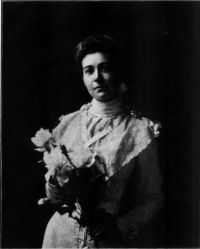
Mary Imlay Taylor

Mary Imlay Taylor

Summary

Portrait of Mary Imlay Taylor Mary Imlay Taylor On the red staircase (1896)

I had been but lately at Versailles, in the midst of the splendors of the Grand Monarque’s brilliant court, and here was a wondrous contrast: here, too, was an absolute monarchy, but without the master hand, the iron grip that keeps the helm of state. Here was a court whose ceremonial was as stately as any in the world; but how strong was the feeling of instability! I looked at the Kremlin; within it lay the dead Feodor, not yet buried, and within it, too, was the young czar,—a child, and a tool as yet in the hands of an intriguing party.
Source: Gutenberg

Portrait of Mary Imlay Taylor Mary Imlay Taylor On the red staircase (1896)

The city was not as quiet as usual at that hour; heavy sounds smote the ear, and the hum of some distant noise coming from the direction of the quarters of the Streltsi. We were riding through the Zemlianui-gorod towards the suburbs, where I was to find the house of the Boyar Urusof. The moon was entirely obscured now, and it was so dark that it required all my attention to guide my horse along the indifferent road,—Pierrot keeping close in my wake and, contrary to his custom, offering no suggestions about our journey, feeling perhaps that he accompanied me only on sufferance.
Source: Gutenberg

Portrait of Mary Imlay Taylor Mary Imlay Taylor On the red staircase (1896)

It was a dull day; the sky was heavy, and the Kremlin wore its most gloomy aspect; even the red pavement of the square was almost obscured by the mass of people, and the voices of the multitude were hushed as the deep notes of the great cathedral bells tolled solemnly, on every hand, the mournful dirge of Russia’s mightiest, laid in the dust to share at last the common fate of his humblest subject,—for how great a leveller is Death!
Source: Gutenberg

Get perspective with Kwize: daily news enlightened by great literature