“ The federal capital of Mexico is in the centre of a country of surpassing richness and beauty, but from the day of its foundation, between seven and eight hundred years ago, it has been the theatre of constant revolutions and bitter warfare, where hecatombs of human beings have been sacrificed upon idolatrous altars, where a foreign religion has been established at the spear's point, through torture by fire and the rack, and where rivers of blood have been ruthlessly spilled in battle, sometimes in repelling a foreign foe, but only too often in still more cruel civil wars. ”
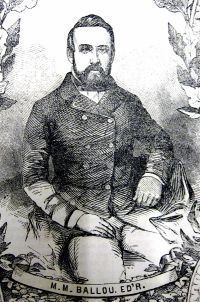
Maturin M. Ballou
Summary
Maturin M. Ballou’s Aztec Land is a 19th-century descriptive and analytical work that explores Mexico’s historical, cultural, and geographical terrain, focusing on its capital, the legacy of Spanish colonization, and the interaction between indigenous traditions and modernity. Through vivid portrayals of plazas, cathedrals, and the Rio Grande, Ballou examines the nation’s turbulent past—marked by revolutions, religious upheaval, and civil conflict—while contrasting its natural beauty with social inequalities, such as the struggles of laborers and the marginalized poor.
The text also reflects on Mexico’s potential for advancement, juxtaposing traditional homes with emerging agricultural developments, and offers insights into the country’s unique identity, distinct from the United States, through its vibrant markets, colonial architecture, and complex social structures.
Quotes from Aztec Land (Maturin M. Ballou)
“ Now a grand comprehensive scene comes before us, a view from the battlements of Chapultepec, from the hill of Guadalupe, or the Pyramid of Cholula, and, above all, that presented from the towers of the superb cathedral of Mexico. This is not an enchanting dream, but the exquisite photography of memory, a store of glowing pictures for future mental enjoyment. It is such experiences and memories which render us never less alone than when alone. ”
“ Mexico is a city of vistas. One looks down the long perspective of a thoroughfare north, south, east, or west, and at the end he sees the purple mountains, some far away, some quite near to view, some apparently three miles off, some sixty; but the air is so transparent that even the most distant objects seem to be very near at hand. Beneath the plain which immediately surrounds the city is a dry marsh which was a broad lake in Cortez's day,—indeed, it is a lake still, four or five feet below the surface of the ground, containing the accumulated drainage of centuries. ”
