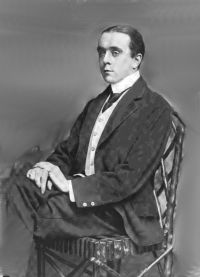
Max Beerbohm

Max Beerbohm

Summary

Portrait of Max Beerbohm Max Beerbohm Zuleika Dobson — Chapter 3 (1911)

He looked her full in the face. It was like seeing suddenly at close quarters some great bright monument that one has long known only as a sun-caught speck in the distance. He saw the large violet eyes open to him, and their lashes curling to him; the vivid parted lips; and the black pearl, and the pink.
"You are very kind," he murmured, in a voice which sounded to him quite far away. "But I always play without notes."
Zuleika blushed. Not with shame, but with delirious pleasure.
Source: Wikisource

Portrait of Max Beerbohm Max Beerbohm Zuleika Dobson — Chapter 3 (1911)

He must not dilute his own soul's essence. He must not surrender to any passion his dandihood. The dandy must be celibate, cloistral; is, indeed, but a monk with a mirror for beads and breviary—an anchorite, mortifying his soul that his body may be perfect. Till he met Zuleika, the Duke had not known the meaning of temptation. He fought now, a St. Anthony, against the apparition. He would not look at her, and he hated her. He loved her, and he could not help seeing her. The black pearl and the pink seemed to dangle ever nearer and clearer to him, mocking him and beguiling.
Source: Wikisource

Portrait of Max Beerbohm Max Beerbohm Zuleika Dobson — Chapter 3 (1911)

As the speaker subsided, the Duke, for the fun of the thing, rose. He made a long speech against the bill. His gibes at the Government were so scathing, so utterly destructive his criticism of the bill itself, so lofty and so irresistible the flights of his eloquence, that, when he resumed his seat, there was only one course left to the Leader of the House. He rose and, in a few husky phrases, moved that the bill "be read this day six months." All England rang with the name of the young Duke. He himself seemed to be the one person unmoved by his exploit.
Source: Wikisource

Get perspective with Kwize: daily news enlightened by great literature