Summary

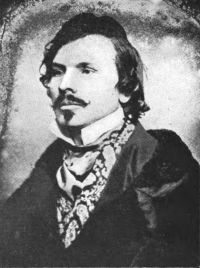
Portrait of Mayne Reid Mayne Reid The Hunters' Feast: Conversations Around the Camp Fire

Night was coming on, but the fierce and obstinate brute showed no disposition to raise the siege. He remained watchful as ever, walking round and round at intervals, lashing his tail, and uttering that snorting sound so well-known, to the prairie-hunter, and which so much resembles the grunting of hogs when suddenly alarmed. Occasionally he would bellow loudly like the common bull.
While watching his various manoeuvres, an object on the ground drew my attention—it was the trail-rope left by my horse.
Source: Gutenberg

Portrait of Mayne Reid Mayne Reid The Hunters' Feast: Conversations Around the Camp Fire

Sometimes whole tracts of country are met with in these regions, whose surface exhibits a pleasing variety of woodland and prairie; sloping hills appear with coppices upon their crests and along their sides. Among these natural groves may be seen troops of the long-tailed deer, browsing along the declivities of the hills, and, by their elegant attitudes and graceful movements, adding to the beauty of the landscape.
Source: Gutenberg

Portrait of Mayne Reid Mayne Reid The Hunters' Feast: Conversations Around the Camp Fire

Of the two dozen species of American wild-ducks, none has a wider celebrity than that known as the canvas-back; even the eider-duck is less thought of, as the Americans care little for beds of down. But the juicy, fine-flavoured flesh of the canvas-back is esteemed by all classes of people; and epicures prize it above that of all other winged creatures, with the exception, perhaps, of the reed-bird or rice-hunting, and the prairie-hen. These last enjoy a celebrity almost if not altogether equal.
Source: Gutenberg

Get perspective with Kwize: daily news enlightened by great literature