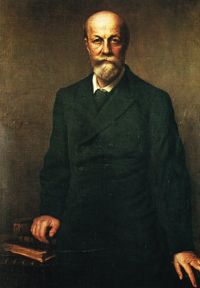

“ But why look at the stars when one cannot speak to them? A heavy load weighs down the heart, a cruel wound makes the soul bleed. If one could pour out the bitterness, if one could complain, perhaps it might be easier. But how vast is the puszta and how void!The shining star set, also the moon. The horse left the pasture and returned to its master. ”
Quotes from The Yellow Rose (Mór Jókai)
“ The two-wheeled mill clattered gaily in the little river, and the otter lived happily among the reeds.At the first streak of dawn, a horseman came riding across the flat Zám puszta, which lies on the far side of the Hortobágy River (taking Debreczin as the centre of the world) . Whence did he come? Whither was he going? Impossible to guess. The puszta has no pathway, grass grows over hoof-print and cart track. Up to the endless horizon there is nothing but grass, not a tree, a well pole, or a hut to break the majestic green plain. The horse went its way instinctively. ”
“ Had he understood bird language, he would have known what the hundreds of little larks were twittering as they rose up out of sight, to greet the dawn. "Wear not—wear not your yellow rose!" But this Hortobágy peasant was hard-headed; he knew neither fear nor superstition.He had wasted a good deal of time, however, in seeking this rose—though possibly more in winning it—for at the watering-hour he should have reached the Zám herd. By this time the overseer must be cursing him roundly. Well, let him curse! When one has a yellow rose in one's cap one is not afraid of an overseer! ”
“ Because when the mad fit comes upon a girl, she simply raves without rhyme or reason. Miss Klári fancies our eyes don't meet each other's often enough, so she has an ill will against me, and now she takes to accusing herself to compel me to let out the other one's name, out of sheer compassion—the pretty lass, to whom I went to lose my soul and cure my heart, and who gave me the charm to drink. ”
“ On the other hand the swarms of horse-flies, gad-flies, and midges appeared more wickedly inclined than ever, and the horse could only get along slowly, having to drive off the blood-thirsty torments, now with its hind-foot, now with its head. Still it never missed the path though the bridle lay slack between the csikós' fingers. Man too feels the approach of a storm.Suddenly, as they reached that substantial triumph of Scythian architecture—the Hortobágy bridge—the csikós started. ”
“ Come here, old fellow," said the csikós.At that the horse began to whinny joyously, and lay down near his master.The herdsman raised himself on his elbows, and rested his head on his hand. Here was someone to speak with—an intelligent beast."You see!" he said. "You see, my Vidám? That is the way with a girl! Outside gold, inside silver. When she speaks the truth it is half false; when she lies it is half true! No one will ever learn to understand her. ”
“ The horses, four to each carriage, flew over the pathless green meadow-land, till, presently, something began to show dark on the horizon—a plantation, the first acacias on the hitherto treeless puszta, and some bluish knolls."Those are the Tartar hills of Zám," explained the Debreczin farmer to his companions. "There stood some village destroyed by the Tartars. The ruins of the church still peep out of the grass, and the dogs, when they dig holes, scrape out human bones." ”
“ The csikós shook his head, and broke the neck of another bottle. He wished to fill his friend's glass, but the cowboy placed his hand over it."You won't drink my beer?""I'm keeping to the rule. Wine on beer—never fear. Beer on wine—no time."The csikós poured himself out the whole bottle, and then began to moralise (the not unfrequent result of beer-drinking) ."See, comrade," he said, "there is no uglier sin in the world than lying. I once lied myself, though not in my own defence, and it has oppressed my soul ever since. Lying does well enough for shepherds, but not for lads on horseback. ”
“ It did the doctor good to pour out the bitterness of his heart before the strangers, but he had no time to admire the marvels of nature, being obliged to hurry back to his animal hospital and pharmacy at Mata. So, bidding adieu to both his old and new friends, he jumped into his gig, and jogged away over the plain.The herd was already scattered far out on the puszta, the cowboys driving it forward. The grass near at hand is more luscious, but in spring the cattle graze far afield, so that when summer scorches the distant pastures, the nearer still remain for them. ”
“ Ferko Lacza does live on the Hortobágy. Had she written, 'Hortobágy inn' even, I should have known where to find him, but how can I go roaming about the Hortobágy, and the Zám puszta, searching the 'karáms' of goodness knows how many herds, and risking my calves among the watch-dogs? I have fought with the woman quite enough about it. Now, at least, I can say I have handed it over at cent. per cent. interest, and we will have no more rows. So accept it, herdsman. You will know how to get the ten florins out of the cowboy, for you fear neither himself nor his dog. ”
“ A dog is honest enough, it is men who know how to lie, and theirs is the true yelping. As for me, it never came into my mind to lie, my tongue is not fashioned that way. Lying ill-suits a moustache, and it's a bad business when bearded lips speak lying words like a coward who fears a beating. Now, see, when the conscription was here last autumn, they summoned us all from the puszta. But the townspeople wanted to keep us, for, without herdsmen the cattle and horses would fare badly. ”
“ Pelikan, lighting himself a cigar from Sándor's."Yes! If he had not been ill!" grumbled the overseer."I wasn't ill!" bragged the herdsman, and tossed back his head contemptuously."What on earth, were you then? When a man lies three days in the Mata Hospital——""How can a man lie in the Mata Hospital? It is only for horses!""What were you doing then?""Drunk!" said Sándor Decsi. "As a man has a right to be!"The old man twisted his moustache, and muttered, half-pleased, half-vexed, "There, you see these 'betyárs'! Not for all the world would they confess anything had ailed them." ”
“ Never shall you leave your master. . . . . Never will he part with you, not though they offer him your weight in gold . . . . my one faithful friend! Do you know how you caught hold of my waistcoat and helped the doctor to lift me up from the ground when I lay on the puszta as good as dead, with the eagles [Pg 154] shrieking over me? You seized my clothes with your teeth, and raised me, you did! . . . . Yes? . . . . You know all about it? . . . . my darling! Do not fear, we will never cross the Hortobágy bridge again, never turn in at the Hortobágy inn. ”
“ Then they would not have taken you as a soldier to Mezöhegyes. It is not wise to leave a girl to herself. It is not wise to let a lilac-bush in blossom overhang the paling, because then every passer-by who chooses can break off a piece!"At these words the very morsel of bread fell from the herdsman's mouth, and he cast it to the dog. ”
“ The ferry-boat had been replaced, and by morning they would be able to cross.Those with carts lost no time in running them on board, and arranging them side by side. Next they took the horses. Then came the turn for the cattle. Room was made for them with difficulty. The crush was great, but mild, after all, to what theatre-goers usually endure!Last of all, the bull, the terror of everyone, was brought, and now no one remained but the herdsman and his horse. The two Moravian drovers took their places between the cows and the carts. ”
“ Now and then a horse neighed.Poor lad! formerly your head would [Pg 150] hardly touch the saddle before you were fast asleep, now you can only gaze and gaze at the dark blue sky overhead, and the stars, whose names your old godfather taught you. There in the midst is the Pole Star, which never moves from its place; those two are the "Herdsman's Team," while that with the changing colour is the "Eye of an Orphan Maid." The brilliant one, just over the horizon, is the "Reaper's Star;" still the "Wanderer's Lamp" is brighter. ”
“ No one can manage the herd as he does, and I did my best to free him from soldiering. Ferko is the godchild of my old friend, the cattle overseer, and a good lad also. Both would be the best friends in the world, [Pg 142] if the devil, or goodness knows what evil fate, hadn't thrown that pale-faced girl in between them. Now they are ready to eat each other. Luckily my old friend had a capital idea, and has sent Ferko to be head herdsman to a Moravian Duke. So peace will once more reign on the Hortobágy. ”
“ One thing is certain—it is no lily-of-the-valley. It is the sole fuel of the puszta herdsman, in fact, a sort of zoological peat.We remember the tale of the Hungarian landowner who, finding it advisable to go abroad after the Revolution, chose free Switzerland as a temporary place of residence. But his eyes never grew used to the high mountains. Every evening, on withdrawing to his room, he would take a piece of "peat," found on the pasture, and laying it on the hearth, kindle it. ”
“ He never sits drinking with shepherds and swineherds.""Then the cowherd is the aristocrat of the puszta?" remarked the manager of the stables."That's it, exactly. Just as counts and barons are among grand folk, so are csikós and cowboys among the other herdsmen.""So there is no equality on the puszta?" [Pg 56] "As long as men are on the earth, there will never be equality," said the overseer. "He who is born a gentleman will remain one, even in a peasant's coat. He will never steal his neighbour's cow or horse, even if he find it straying, but will drive it back to its owner. ”
“ I don't like the way he is going on—head over ears in love with that pale-faced girl at the Hortobágy inn. 'Tis a bad business. The girl has a sweetheart already. A csikós, who is away soldiering; and if he comes home on leave and the lads meet, it will be like two angry bulls who mean business. Much better that he should go away and take to some pretty little Annie up there, and forget all about his yellow rose. ”
“ Gendarmes are honest men, and do their duty. As for a good-for-nothing 'betyár,' he sets a girl to watch outside, and as soon as he sees so much as the tip of a gendarme's helmet, he is off and away, 'O'er the boundless waste,' leaving fish and wine and all behind him. ”
“ I might if I weren't chained fast to you and to this puszta. Why, I am your slave.""Not exactly," said the man. "You know it is not like that; but whoever you have bewitched with those eyes of yours must come back from the ends of the earth to you. You give him a charm to drink that compels him to think of you. Or you sew one of your hairs in his shirt sleeve, that you may draw him back, even from beyond the stars. ”
“ One of them, a lovely girl, with eyes like sloes, who was standing outside, spoke to me, and invited me in. They were roasting a sucking pig, and we enjoyed ourselves. I drank their wine, and at once felt that it had a bitter taste; but the kisses of the gypsy lass were so sweet that I forgot all about it." [Pg 103] "You lie, lie, lie!" shrieked the girl. "You have invented that story this very minute!"The herdsman laughed loudly, clapped one hand to the crown of his head, snapped his fingers in the air, and started his favourite song: "Why not love this world of ours? ”
“ Every ordinary, self-respecting Hungarian carries his own supply in his knapsack; but after a three days' famine even "paprika" will give out! Nevertheless, no "paprika," no fish stew."I have some," said the cowboy, and pulled a wooden box from his sleeve. Every one noted what a far-seeing man he must be to reserve his own "paprika" for the [Pg 122] last extremity, and henceforth regarded him as the saviour of the party.The stew-pot was in the end of the ferry-boat, and to reach it the herdsman traversed its whole length, the cattle being stationed about the middle. ”
“ Along the horizon lay a quivering sea, where high waves chased each other from east to west, the real hills standing out as little islands in their midst, and the stumpy acacias magnified into vast forests. ”
“ Fighting with swords on horseback is an art, but the sword where it strikes inflicts a wound not easily forgotten. He who wields the cudgel must aim his blow for the one instant when his galloping steed meets his opponent's. There is no parrying possible, no thrusting aside of the stroke. Who strikes truest wins the day. [Pg 183] The two herdsmen, meeting at the cudgel's length, struck at each other's head, then dashed past on their horses.Sándor Decsi shook in the saddle, his head fell forward from the force of the blow, but tossing it back directly, he straightened his crumpled cap. ”
“ From the corral in the centre, all round to the wide circle of horizon, nothing can be seen but horses grazing. Horses of all colours, which only the richness of the Hungarian language can find names for: bay, grey, black, white-faced, piebald, dappled, chestnut, flea-bitten, strawberry, skewbald, roan, cream-coloured, and, what is rarest among foals, milk-white. Well does this variety of shade and colour deserve to be called the "mixed" herd. A gentleman's stud is something very different, there only horses of one breed and colouring are to be found. ”
“ The passengers found much exercise for their wit in this cattle incident. The ferry-men assured them with oaths that it was not the first time by any means that it had happened. Beasts brought from the Hortobágy so often were assailed by home sickness that no sooner was the ferry-boat put in motion than they would turn restive and spring overboard, swim to the bank, and run back to the puszta."Men have the same love of home and country," said the ginger-bread man, who, having often read of it in books, recognised the complaint. ”
“ The painter looked forward to seeing a sunrise on the puszta, a sight which no one, who has not viewed it with his own eyes, can form the slightest idea of. The practical reason was that the cattle to be sold could only be separated from the herd in the early morning. In spring, most of them have little calves, and at dawn, when these are not sucking, the herdsmen going in among the herd, catch those whose mothers have been selected and take them away. The mothers then follow of their own accord. ”
“ Sándor Decsi laughed loud, till his row of fine white teeth flashed."A csikós, and a bill!""Well, your worthy friend, Mr. Ferko Lacza is quite another gentleman, and he is only a cowherd. He knows what a bill means. I have just such a long paper of his, if you would like to see it."He searched among his documents, and holding one before the csikós, finally handed him the paper. The bill amounted to ten florins."Does Mr. Pelikan know the cowboy?" asked the astonished csikós."As far as I know, you do not deal with cattle, sir." ”
“ The artist was a famous landscape painter from Vienna, who often came to Hungary for the sake of his work, and who spoke the tongue of the people. The other Viennese was manager of the stables to the Moravian landowner, Count Engelshort. It would, perhaps, have been wiser to have sent some farmer who knew about cattle, for a lover of horses has little mind left for anything else. But he had this advantage over the rest of the staff, that he knew Hungarian, for when a lieutenant of Dragoons he had long been stationed in Hungary, where the fair ladies had taught him to speak it. ”
“ When my turn came to be inspected they made out that my heart beat irregularly. 'Well, if it beats irregularly,' said I, 'it is not my heart that's in fault, but the Yellow Rose yonder, at the Hortobágy inn.' The gentlemen all nudged me to trust to the doctor, who said I had enlargement of the heart! 'Why, it's just big enough to hold one little bit of a girl, and nothing else. There is nothing in the world the matter with me!' So they took me for a soldier, but respected me. They never even cut my hair, but sent me to be 'soldier csikós' to the military stud at Mezöhegyes. ”
Common terms
Similar works
Jack the Young Cowboy: An Eastern Boy's Experiance on a Western Round-up…The Pony Rider Boys in Texas; Or…Memories of Old Montana (Con Price…Redskin and Cow-Boy: A Tale of the Western Plains…Cowboy Songs, and Other Frontier Ballads…Wells Brothers: The Young Cattle Kings…The Passing of the Frontier: A Chronicle of the Old West…Cattle and Cattle-breeders (William McCombie…Reed Anthony, Cowman: An Autobiography…George in Camp; or, Life on the Plains…
