Summary

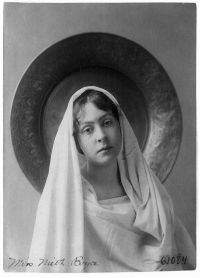
Portrait of Neith Boyce Neith Boyce The Folly of Others — Sophia (1904)

Larkins himself, in his tri-weekly performance of the melancholy rite of shaving, had observed them. He had never been much given to observing himself, nor, in fact, to thinking any more than he was obliged in the course of his business. Thus it had never occurred to him to blame Sophia for the fact that he was less comfortable in the boarding-house than he had been in the flat.
Source: Wikisource

Portrait of Neith Boyce Neith Boyce The Folly of Others — Sophia (1904)

Larkins thought that the spangled toreador's jacket looked like the things she used to make.
Sophia had always been proud of her figure and her voice, justly, Mr. Larkins thought. He had admired his wife very much, but as nature had denied him the gift of expression, and also because he was a man, he was not able to tell her so often enough to satisfy her. Sophia had yearned for a wider field, or as she put it, she wanted a change. As a result the Harlem flat had been given up; Mr. Larkins was living in one boarding-house and Sohpia in another.
Source: Wikisource

Portrait of Neith Boyce Neith Boyce The Folly of Others — Sophia (1904)

At the beginning of the performance the matter-of-fact man had looked to see if the names of the toreadors appeared on the programme, and, finding they did not, had dropped it under his feet. He now sat leaning forward, his damp overcoat reposing on the rail before him and his short-sighted eyes peering through glasses at the undulating choral ranks.
Source: Wikisource

Get perspective with Kwize: daily news enlightened by great literature