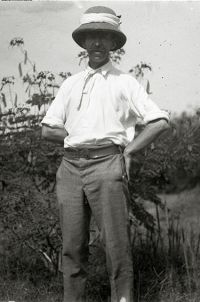
Northcote Whitridge Thomas

Northcote Whitridge Thomas

Summary

Portrait of Northcote Whitridge Thomas Northcote Whitridge Thomas 1911 Encyclopædia Britannica, Volume 10… (1911)

Any classification, however, labours under the disadvantage of separating items which properly belong together. Thus, myths are obviously the form in which some superstitions are expressed. They may also be aetiological in their nature and form an elaborate record of a custom. Eschatological beliefs naturally take the form of myths. Traditional narratives can also be classified under art, and so on.
Literature.—The literature of the subject falls into two sharply defined classes—synthetic works and collections of folklore—of which the latter are immensely more numerous.
Source: Wikisource

Portrait of Northcote Whitridge Thomas Northcote Whitridge Thomas 1911 Encyclopædia Britannica, Volume 10… (1911)

With the growth of our knowledge of European folk-custom and belief on the one hand, and of rites and religions of people in the lower stages of culture on the other hand, it has become abundantly clear that there is no line of demarcation between the two. Each throws light upon the other, and the superstitions of Europe are the lineal descendants of savage creeds which have their parallels all over the world in the culture of primitive peoples.
Subdivisions.—The folklore of civilized peoples may be conveniently classified under three main heads: (1) belief and custom
Source: Wikisource

Portrait of Northcote Whitridge Thomas Northcote Whitridge Thomas 1911 Encyclopædia Britannica, Volume 10… (1911)

The term folklore is also used to designate the science which deals with folklore; the study of survivals involves the investigation of the similar customs, beliefs, &c., of races on lower planes of culture; consequently folklore, as interpreted by the English and American societies, concerns itself as much or more with savage races as with the popular superstitions of the white races.
History.—The scientific study of folklore dates back to the first quarter of the 19th century, but folklore was collected long before that date. The organized study of folklore is a thing of recent growth.
Source: Wikisource

Get perspective with Kwize: daily news enlightened by great literature