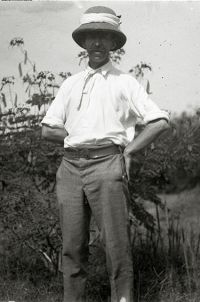
Northcote Whitridge Thomas

Northcote Whitridge Thomas

Summary

Portrait of Northcote Whitridge Thomas Northcote Whitridge Thomas 1911 Encyclopædia Britannica, Volume 8… (1911)

Thus, the Koreans go far beyond the Eskimo and number their demons by thousands of billions; they fill the chimney, the shed, the living-room, the kitchen, they are on every shelf and jar; in thousands they waylay the traveller as he leaves his home, beside him, behind him, dancing in front of him, whirring over his head, crying out upon him from air, earth and water.
Source: Wikisource

Portrait of Northcote Whitridge Thomas Northcote Whitridge Thomas 1911 Encyclopædia Britannica, Volume 8… (1911)

The so-called Spectre Huntsman of the Malay Peninsula is said to be a man who scours the firmament with his dogs, vainly seeking for what he could not find on earth—a buck mouse-deer pregnant with male offspring; but he seems to be a living man; there is no statement that he ever died, nor yet that he is a spirit. The incubus and succubus of the middle ages are sometimes regarded as spiritual beings; but they were held to give very real proof of their bodily existence. It should, however, be remembered that primitive peoples do not distinguish clearly between material and immaterial beings.
Source: Wikisource

Portrait of Northcote Whitridge Thomas Northcote Whitridge Thomas 1911 Encyclopædia Britannica, Volume 8… (1911)

So too, many of the spirits especially concerned with the operations of nature are conceived as neutral or even benevolent; the European peasant fears the corn-spirit only when he irritates him by trenching on his domain and taking his property by cutting the corn; similarly, there is no reason why the more insignificant personages of the pantheon should be conceived as malevolent, and we find that the Petara of the Dyaks are far from indiscriminating and malignant, though disease and death are laid at their door.
Source: Wikisource

Get perspective with Kwize: daily news enlightened by great literature