“ Yet, in those hills that hung o'er Arcady, Some roving inebriate Daimon Begat him fair children On nymphs of the vineyard, On nymphs of the rock: — And in the heart of the forest Lay bound in white arms, In action creative a father Without a thought for his child: — A purposeless god, The forbear of men To corrupt, ape, inherit and spoil That fine race beforehand with doom! No, Damon, what's an answer worth to one Whose mind has been flung open? ”
Daimon
Definition and stakes
Quotes about “daimon”
Douglas Pulleyne, The frantic master (1927)
“ His brain groped around in the dark awhile before he found an answer. "There is a daimon in every man," he insisted in low tones, speaking more to himself than to her, "which forces upon him the knowledge when a thing is not Right, even though it may be Natural." And then, that very daimon, thus invoked, spoke to him in the ensuing silence. The same child who had fallen asleep on his shoulder in the past was beside him now, expectant of the same "crystallized apricot" of comfort. Let him take heed that it was such comfort as healed and did not merely drug. ”
Aeschylus,
The Agamemnon of Æschylus
(1877)
“ And throw out such words—the Daimon's power experimenting on— And, of modest knowledge missing,—me, the ruler, . . . CHOROS. Ne'er may this befall Argeians—wicked man to fawn before! AIGISTHOS. Anyhow, in after days, will I, yes, I, be at thee yet! CHOROS. Not if hither should the Daimon make Orestes straightway come! AIGISTHOS. O, I know, myself, that fugitives on hopes are pasture-fed! CHOROS. Do thy deed, get fat, defiling justice, since the power is thine! AIGISTHOS. Know that thou shalt give me satisfaction for this folly's sake! ”
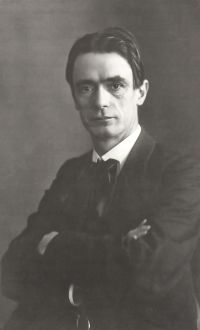
Rudolf Steiner,
Christianity As Mystical Fact
(1914)
“ One who has arrived at this knowledge looks beyond himself, backwards and forwards. The daimonic experiences through which he has passed are enough to prove to him his own immortality. And he can no longer limit his daimon to the one function of occupying his personality, for the latter can only be one of the forms in which the daimon is manifested. The daimon cannot be shut up within one personality, he has power to animate many. He is able to transform himself from one personality into another. ”
“ Eros, O Socrates, is a daimon, a great daimon, and everything of this nature is intermediate between God and man. The daimon transfers to the Gods what comes from man, and to man what comes from the Gods; from the one prayer and sacrifice, from the other the orders and rewards for the sacrifice. Midway, he fills the gap between the immortal and the mortal, and everything is through him bound into one whole. By his mediation is disseminated every prophecy and the religious skill which has reference to sacrifice, sanctification, sacred maxims, and each prediction and [199] magic spell. ”
Rudolf Steiner,
Christianity As Mystical Fact
(1914)
“ I am working for a future personality. Between me and the Spirit of the Universe, something interposes which reaches beyond me, but is not yet the same as divinity. This something is my daimon. My to-day is only the product of yesterday, my to-morrow will be the product of to-day; in the same way my life is the result of a former and will be the foundation of a future one. Just as mortal man looks back to innumerable yesterdays and forward to many to-morrows, so does the soul of the sage look upon many lives in his past and many in the future. ”
John W. Mollett, An Illustrated Dictionary of Words used in Art and Archaeology (1883)
“ Dædala, Gr. (δαίδαλα) . Festivals in honour of Hera, celebrated in Bœotia.Dæmon, Daimon, Gr. (δαίμων) . The good genius who watched over an individual during his whole life, like the Latin Lar and Genius. It was the belief of Socrates that he was guided by his Daimon in every important act and thought of his life. The word has a general meaning of “Divinity.”Dag or Dagge. Old English name of a pistol.Dagges, O. E. Ornamental cutting of the edges of garments, introduced into England about 1346. (See the illustration to Cointise, Fig. 177) .Dagob, Hindoo. ”
H. P. Blavatsky,
Isis unveiled, Volume 1 (of 2)…
(1878)
“ One thing, however, distinguishes him from the living man, viz.: that when a man’s limbs are once divided, their parts cannot be reunited very easily. But, cut a demon in two, and you will see him immediately join himself together. As water or air closes in behind a solid body [585] passing through it, and no trace is left, so does the body of a demon condense itself again, when the penetrative weapon is withdrawn from the wound. But every rent made in it causes him pain nevertheless. That is why daimons dread the point of a sword or any sharp weapon. ”
William Alexander Caruthers, The Kentuckian in New-York; or…
“ Damon took all that sort of work off our hands, in the most generous and chivalrous spirit imaginable. His eye was ever bright and ready; there was no sinking into dull student-like lethargy one moment, and flashing out into erratic folly the next; he was ready with lance in rest, to take a tilt against anybody's windmill; at home upon all subjects, being exactly in such a state of refinement as not to be ashamed to show his ignorance, and always eager to acquire information. Nor is his mind dull or unapt; he will rebut or ridicule an adversary with astonishing shrewdness. ”
Henry Iliowizi, The Weird Orient: Nine Mystic Tales
“ The mountains trembled, the air grew oppressive and seemed saturated with fetid gases. A moment’s ominous quiet was broken by another far-reaching convulsion, followed by a crack which terrified the gods and threw Damon out of his seat deep down into a chasm. The womb of Erebus opened wide. A deluge of fire burst from the bowels of the earth, melting glaciers and causing frozen seas to boil. Heaven glowed like a furnace, and Damon beheld with terror a stream of liquid metal pour down in a cataract from a height above his head. His attempt to flee from destruction proved his limbs to be of lead ”
A Select Collection of Old English Plays
“ A pledge you did require, when Damon his suit did meve,For which with heart and stretched hands most humble thanks I give:And that you may not say but Damon hath a friend,That loves him better than his own life, and will do to his end,Take me, O mighty king: my life I pawn [75] for his:Strike off my head, if Damon hap at his day to miss. Dionysius. What art thou, that chargest me with my word so boldly here? Pithias. I am Pithias, a Greek born, which hold Damon my friend full dear. Dionysius. Too dear perhaps, to hazard thy life for him: what fondness [76] moveth thee? ”
John Milton,
An Introduction to the Prose and Poetical Works of John Milton
“ Thyrsis, having set out to travel for mental improvement, received news when abroad of Damon's death. Afterwards at length returning, and finding the matter to be so, he deplores himself and his solitary [51] condition in the following poem. Under the guise of Damon, however, is here understood Charles Diodati, tracing his descent on the father's side from the Tuscan city of Lucca, but otherwise English—a youth remarkable, while he lived, for his genius, his learning, and other most shining virtues.''Go unpastured, my lambs: your master now heeds not your bleating. ”
A Select Collection of Old English Plays
“ Both to break my promise, and to suffer me to see thee die,Whom so dearly I love: this small request grant me,I shall never ask thee more, my desire is but friendly.Do me this honour, that fame may report triumphantly,That Pithias for his friend Damon was contented to die. Damon. That you were contented for me to die, fame cannot deny;Yet fame shall never touch me with such a villainy,To report that Damon did suffer his friend Pithias for him guiltless to die;Therefore content thyself, the gods requite thy constant faith,None but Damon’s blood can appease Dionysius’ wrath. ”
A Select Collection of Old English Plays
“ The gods now I know have heard my fervent prayer,That they have reserved me to this passing great honour,To die for my friend, whose faith even now I do not mistrust;My friend Damon is no false traitor, he is true and just:But sith he is no god, but a man, he must do as he may,The wind may be contrary, sickness may let him, [140] or some misadventure by the way,Which the eternal gods turn all to my glory,That fame may resound how Pithias for Damon did die:He breaketh no oath which doth as much as he can,His mind is here, he hath some let, he is but a man. ”
Fannie Louise Apjohn, The Enchanted Island
“ They waited until it was quite dark and then dug a hole inside the opening at the back of the cave, and made a fire. Luckily Daimur had a little silver box of matches with him. They roasted the potatoes and yams in the coals, toasted the peanuts, and baked the turtle eggs on a hot stone, and thoroughly enjoyed their supper. Then, as they were all very tired, Daimur jammed some branches across one corner of the cave for the doves to sleep on, and gratefully threw himself down on the nice soft bed which the Queen and the Princess had prepared for him, and they all slept soundly until morning. ”
H. B. Marriott Watson,
The High Toby
“ With that, seeming to recognise the folly of resistance, Sir Damon sank back in his seat."What is't you want?" he asked in another voice."'Tis very simple," says t'other; "merely all that is in your chaise with you, save what clothes you sit in." And now that the man's head no longer blocked the window he pressed closer in, and at the same instant uttered an exclamation of surprise. And so I daresay did Sir Damon also, for he must have recognised by that saying with whom he had to deal; the which must have astonished him who came forth to see the young buck laid by the heels. ”
A Select Collection of Old English Plays
“ When there were [111] not so many captious fellows as now,That would torup [112] men for every trifle, I wot not how:As there was one Damon, not long since taken for a spy;How justly I know not, but he was condemned to die. Will (aside.) This wine hath warmed him, this comes well to pass,We shall know all now, for in Vino veritas.Father Grim, who accused this Damon to King Dionysius? Grim. A vengeance take him! ’twas a gentleman, one Master Crowsphus. Will. Crowsphus! you clip the king’s language, you would have said Carisophus. ”
Fannie Louise Apjohn, The Enchanted Island
“ They hastened back to where they had left the yams, and taking off his coat Daimur threw them into it and they started off towards the cave. When they drew near it the Queen and Princess came flying to meet them, and crying that they had found a great treasure. "What have you found?" asked Daimur in surprise, hoping it was not another of the Evil Magician's wicked devices. "Water," replied the Queen. "It is just outside the cave and bubbles up from between two rocks. It must be a natural spring as it tastes quite pure and fresh." ”
Fannie Louise Apjohn, The Enchanted Island
“ Daimur announced his intention of trying to scale the wall, but even as he spoke a sudden gust of wind swept down upon them, causing the trees to scatter fruit in all directions, and almost upsetting the three doves. "What did I tell you?" said King Cyril. "We do not get much of it here, but look how the treetops are bending above us. It is of no use to try to climb up." Feeling rather disconsolate Daimur turned around and started following the great wall of rock which ran away around the hill, winding in and out until it ran right into the sea. ”
Lewis Spence,
Myths & Legends of Babylonia & Assyria
“ Thus in the Bible story only the 'stump' or fish's tail of Dagon was left to him. In some of the Ninevite sculptures of this deity, the head of the fish forms a kind of mitre on the head of the man, while the body of the fish appears as a cloak or cape over his shoulders and back. This is a sure sign to the mythological student that a god so adorned is in process of quitting the animal for the human form. ”
Plutarch,
Plutarch's Lives
(1864)
“ A Roman captain of a company that wintered in Chæronea became passionately fond of this youth, who was now pretty nearly grown a man. And finding all his approaches, his gifts, and his entreaties alike repulsed, he showed violent inclinations to assault Damon. Our native Chæronea was then in a distressed condition, too small and too poor to meet with any thing but neglect, Damon, being sensible of this, and looking upon himself as injured already, resolved to inflict punishment. ”
A Select Collection of Old English Plays
“ Whom Carisophus accused: Damon is now at liberty,For whose return Pithias his friend lieth in prison, alas, in great jeopardy.To-morrow is the day, which day by noon if Damon return not, earnestlyThe king hath sworn that Pithias should die;Whereof Pithias hath intelligence very secretly,Wishing that Damon may not return, till he hath paidHis life for his friend. Hath it been heretofore ever said,That any man for his friend would die so willingly?O noble friendship! O perfect amity! ”
A Select Collection of Old English Plays
“ I heard Dionysius with his own mouth give this cruel sentenceBy these express words: that Damon the Greek, that crafty spy,Without further judgment to-morrow should die:Believe me, Pithias, with these ears I heard it myself. Pithias. Then how near is my death also! Ah, woe is me!Ah my Damon, another myself, shall I forego thee? Stephano. Sir, there is no time of lamenting now: it behoveth usTo make means to them which can do much with Dionysius,That he be not made away, ere his cause be fully heard; for we seeBy evil report things be made to princes far worse than they be. ”
A Select Collection of Old English Plays
“ O my Pithias, my noble pledge, my constant friend! Ah! woe is me! for Damon’s sake, how near were thou to thy end!Give place to me, this room is mine, on this stage must I play.Damon is the man, none ought but he to Dionysius his blood to pay. Gronno. Are you come, sir? you might have tarried, if you had been wise:For your hasty coming you are like to know the price. Pithias. O thou cruel minister, why didst not thou thine office?Did I not beg thee make haste in any wise?Hast thou spared to kill me once, that I may die twice?Not to die for my friend is present death to me; and alas! ”
Mrs. Lang, The Red Book of Heroes
“ Such was the state of things when Father Damien reached Molokai, and in spite of his own efforts, aided sometimes by a few of the stronger and more good-natured of the lepers, such it remained for many months. The poor creatures seem to have grown indifferent to their miseries, or only tried to forget them by getting drunk. Happily the end was at hand; for when a violent gale had blown down all their huts it was plain, even to them, that something must be done, and Father Damien wrote at once to Honolulu the news of the plight they were in. ”
Charles King, From School to Battle-field: A Story of the War Days
“ It is more than the youngster can stand. Long-legged Damon, short-legged Pythias, the two have been friends since Third Latin days and chums for over a year. Shorty springs after the retreating forms, but halts short at sound of his name, called in imperative tone from above. At the open window stands the Doctor gazing out. He uses no further words. His right hand is occupied with his snowy cambric handkerchief. With his left he makes two motions. He curves his finger [71] inward, indicating plainly "Come back!" and then with the index points down the avenue, meaning as plainly "Go!" ”
“ The Syracusans told Damon that he would have to die for his faithless friend, but Damon showed no anxiety. At length the very day and hour upon which the condemned man was to die came round. But a few minutes before the fatal time Pythias rushed in, and having warmly embraced his friend, he went forward to take his place. Dionysius was so struck by the conduct of the two men that he pardoned Pythias, and calling him and Damon to his side he entreated them to allow him to be a third in their friendship. ”
Iwaya Sazanami,
The Japanese Fairy Book
(1908)
“ At last he climbed to the spot where the tree divided into two great branches, and taking up his position here, the old man sat down and scattered the ashes right and left all over the branches and twigs. Wonderful, indeed, was the result! The withered tree at once burst into full bloom! The Daimio was so transported with joy that he looked as if he would go mad. He rose to his feet and spread out his fan, calling the old man down from the tree. He himself gave the old man a wine cup filled with the best sake, and rewarded him with much silver and gold and many other precious things. ”