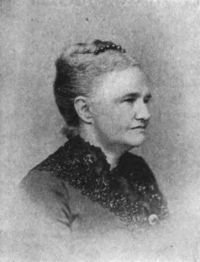
Olive Thorne Miller

Olive Thorne Miller

Summary

Portrait of Olive Thorne Miller Olive Thorne Miller A Bird-Lover in the West

This bird's nest, as well as his song, is unlike that of our wood-pewee. Instead of a delicate, lichen-covered saucer set lightly upon a horizontal crotch of a dead branch,—our bird's chosen home,—it is a deeper cup, fastened tightly upon a large living branch, and, at least in a cottonwood grove, decorated on the outside with the fluffy cotton from the trees.
Even the humming-bird, who contents himself in this part of the world with a modest hum, heard but a short distance away, at the foot of the Rocky Mountains may almost be called a noisy bird.
Source: Gutenberg

Portrait of Olive Thorne Miller Olive Thorne Miller A Bird-Lover in the West

As the time approaches when each bird leaves society and retires for a season to the bosom of its own family, many of the feathered residents of the State bethink them of their inaccessible cañons. The saucy jay abandons the settlements where he has been so familiar as to dispute with the dogs for their food, and sets up his homestead in a tall pine-tree on a slope which to look at is to grow dizzy; the magpie, boldest of birds, steals away to some secure retreat; the meadow-lark makes her nest in the monotonous mesa, where it is as well hidden as a bobolink's nest in a New England meadow.
Source: Gutenberg

Portrait of Olive Thorne Miller Olive Thorne Miller A Bird-Lover in the West

The morning bird chorus in the cottonwood grove where I spent my June was a great shock to me. If my tent had been pitched near the broad plains in which the meadow-lark delights, I might have wakened to the glorious song of this bird of the West. It is not a chorus, indeed, for one rarely hears more than a single performer, but it is a solo that fully makes up for want of numbers, and amply satisfies the lover of bird music, so strong, so sweet, so moving are his notes.
Source: Gutenberg

Get perspective with Kwize: daily news enlightened by great literature