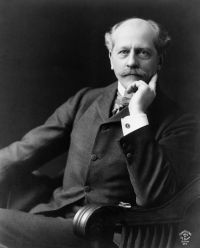
Percival Lowell

Percival Lowell

Summary

Portrait of Percival Lowell Percival Lowell,  Mars. II. The Water Problem (1895)

“ There is a certain peculiarity about the surface markings of Mars, which is pretty sure to strike any thoughtful observer who examines the planet with a two or a three inch object-glass, — their singular sameness night after night. With quite disheartening regularity, each evening presents him with the same appearance he noted the evening before, — a dark band obliquely belting the disc, strangely keeping its place in spite of the nightly progression of the meridians ten degrees to the east, in consequence of our faster rotation gaining on the slower rotation of Mars. ”
Source: Wikisource

Portrait of Percival Lowell Percival Lowell,  Mars. II. The Water Problem (1895)

“ Mars is, apparently, in this distressing plight at the present moment, the signs being that its water supply is now exceedingly low. If, therefore, the planet possess inhabitants, there is but one course open to them in order to support life. Irrigation, and upon as vast a scale as possible, must be the all-engrossing Martian pursuit. So much is directly deducible from what we have learned recently about the physical condition of the planet, quite apart from any question as to possible inhabitants. ”
Source: Wikisource

Portrait of Percival Lowell Percival Lowell,  Mars. II. The Water Problem (1895)

“ If Mars be capable of supporting life, there must be water upon his surface; for to all forms of life water is as vital a matter as air. To all organisms water is absolutely essential. Oh the question of habitability, therefore, it becomes all important to know whether there be water on Mars.
Any one looking through a telescope planet, early last summer, would have been struck by markings in three colors, —white, blue-green, and reddish ochre; the white lying in a great oval was the south polar ice-cap. In the polar cap our water problem takes its rise.
”
Source: Wikisource

Get perspective with Kwize: daily news enlightened by great literature