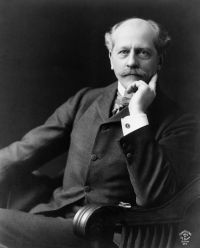
Percival Lowell

Percival Lowell

Summary

Portrait of Percival Lowell Percival Lowell Mars. III. Canals (1895)

Now, at this point in our investigation, when the broad features of Mars disclose conditions which imply irrigation as their organic corollary, we are suddenly confronted on the planet’s face with phenomena so startlingly suggestive of this very thing as to seem to uncanny realization of the deduction. Indeed, so amazingly lifelike is their appearance that, had we possessed our present knowledge of the planet’s physical condition before, we might almost have predicted what we see as criterion of the presence of living beings.
Source: Wikisource

Portrait of Percival Lowell Percival Lowell Mars. III. Canals (1895)

That what we see is not the canal proper, but the line of land it irrigates, disposes incidentally of the difficulty of conceiving a canal several miles wide. On the other hand, a narrow, fertilized strip of country is what we should expect to find; for, as we have seen, the general physical condition of the planet leads us to the conception, not of canals for waterways, - like our Suez Canal, - but of canals dug for irrigation purposes.
Source: Wikisource

Portrait of Percival Lowell Percival Lowell Mars. III. Canals (1895)

Douglass has made the discovery that they are not the only part of the planet thus privileged. He finds, in the very midst of the dark regions themselves, straight, dark steaks not unlike in look to the canals, and still more resembling them in the systematic manner in which the run. For they reproduce the same rectilinear arrangement that is so striking a characteristic of their bright-area fellows. He has succeeded, indeed, in thus triangulating all the more important dark areas.
Source: Wikisource

Get perspective with Kwize: daily news enlightened by great literature