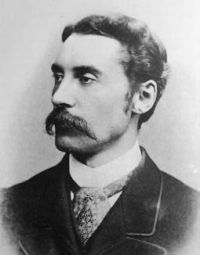
Percy Alexander MacMahon

Percy Alexander MacMahon

Summary

Portrait of Percy Alexander MacMahon Percy Alexander MacMahon 1911 Encyclopædia Britannica, Volume 6… (1911)

The distributions to be considered are such that any number of objects may be in any one class subject to the restriction that no class is empty. Two cases arise. If the order of the objects in a particular class is immaterial, the class is termed a parcel; if the order is material, the class is termed a group. The distribution into parcels is alone considered here, and the main problem is the enumeration of the distributions of objects defined by the partition (pqr . . . ) of the number n into parcels defined by the partition (p1q1r1 . . . ) of the number m.
Source: Wikisource

Portrait of Percy Alexander MacMahon Percy Alexander MacMahon 1911 Encyclopædia Britannica, Volume 6… (1911)

To illustrate an important dissection of the graph we will consider those graphs which read the same by columns as by lines; these are called self-conjugate. Such a graph may be obviously dissected into a square, containing say θ2 nodes, and into two graphs, one lateral and one subjacent, the latter being the conjugate of the former. The former graph is limited to contain not more than θ parts, but is subject to no other condition.
Source: Wikisource

Get perspective with Kwize: daily news enlightened by great literature