Summary

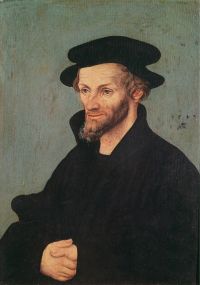
Portrait of Philipp Melanchthon Philipp Melanchthon Treatise on the Power and Primacy of the Pope (1537)

First, because he takes to himself the right to change the doctrine of Christ and services instituted by God, and wants his own doctrine and his own services to be observed as divine; secondly, because he takes to himself the power not only of binding and loosing in this life, but also the jurisdiction over souls after this life; thirdly, because the Pope does not want to be judged by the Church or by any one, and puts his own authority ahead of the decision of Councils and the entire Church. But to be unwilling to be judged by the Church or by any one is to make oneself God.
Source: Wikisource

Portrait of Philipp Melanchthon Philipp Melanchthon Treatise on the Power and Primacy of the Pope (1537)

For it is manifest that the kingdom of Christ is scattered throughout the whole world; and to-day there are many churches in the East which do not seek ordination or confirmation from the Roman bishop [which have ministers ordained neither by the Pope nor his bishops] . Therefore, since such superiority [which the Pope, contrary to all Scripture, arrogates to himself] is impossible, and the churches in the greater part of the world have not acknowledged [nor made use of] it, it is sufficiently apparent that it was not instituted [by Christ, and does not spring from divine law] .
Source: Wikisource

Portrait of Philipp Melanchthon Philipp Melanchthon Treatise on the Power and Primacy of the Pope (1537)

Also, when for a long time there had been contests concerning the primacy between the bishops of Rome and Constantinople, the Emperor Phocas finally determined that the primacy should be assigned to the bishop of Rome. But if the ancient Church had acknowledged the primacy of the Roman Pontiff, this contention could not have occurred, neither would there have been need of the decree of the emperor.
Source: Wikisource

Get perspective with Kwize: daily news enlightened by great literature