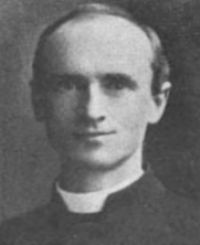
George Hayward Joyce

George Hayward Joyce

Summary

Portrait of George Hayward Joyce George Hayward Joyce Catholic Encyclopedia (1913) — Pope (1913)

Because it would be too long in such a volume as this to enumerate the successions of all the churches, we point to the tradition of that very great and very ancient and universally known Church, which was founded and established at Rome, by the two most glorious Apostles, Peter and Paul: we point I say, to the tradition which this Church has from the Apostles, and to her faith proclaimed to men which comes down to our time through the succession of her bishops, and so we put to shame . . . all who assemble in unauthorized meetings.
Source: Wikisource

Portrait of George Hayward Joyce George Hayward Joyce Catholic Encyclopedia (1913) — Pope (1913)

Such an objection is utterly fallacious. We are dealing here, not with the statements of an individual, but with the tradition of a Church — of that Church which, even from the earliest times, was known for the purity of its doctrine, and which had had for its founders and instructors the two chief Apostles, St. Peter and St. Paul. That tradition, moreover, is absolutely unbroken, as the pronouncements of the long series of popes bear witness. Nor does it stand alone.
Source: Wikisource

Portrait of George Hayward Joyce George Hayward Joyce Catholic Encyclopedia (1913) — Pope (1913)

It is through her union with Peter, Christ continues, that the Church will prove the victor in her long contest with the Evil One: "The gates of hell shall not prevail against it." There can be but one explanation of this striking metaphor. The only manner in which a man can stand in such a relation to any corporate body is by possessing authority over it. The supreme head of a body, in dependence on whom all subordinate authorities hold their power, and he alone, can be said to be the principle of stability, unity, and increase.
Source: Wikisource

Get perspective with Kwize: daily news enlightened by great literature