Summary

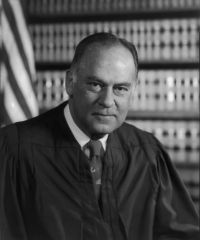
Portrait of Potter Stewart Potter Stewart Oestereich v. Selective Service System Local Board No…

For it is they who must choose whether to run the serious risk of a criminal prosecution or submit to induction with the uncertain hope of prevailing in a habeas corpus proceeding. Yet the Court has made plain today in Clark v. Gabriel, supra, that a registrant whose exemption from service is not clear will under § 10 (b) (3) be put to just such a fateful choice. In light of Gabriel, the allowance of pre-induction review in the present case thus stands as all the more irrational and unjustified.
Source: Wikisource

Portrait of Potter Stewart Potter Stewart Oestereich v. Selective Service System Local Board No…

The section provides for review 'after the registrant has responded either affirmatively or negatively to an order to report for induction * * *.' (Emphasis added.) The remedy for one who responds affirmatively cannot, of course, be by way of 'defense to a criminal prosecution' for refusing to be inducted; the only remedy in such a case is habeas corpus, and the Senate Committee Report made quite clear Congress' understanding in this regard:
'A registrant who presents himself for induction may challenge his classification by seeking a writ of habeas corpus after this induction.
Source: Wikisource

Portrait of Potter Stewart Potter Stewart Oestereich v. Selective Service System Local Board No…

The registrant with a clear statutory exemption is precisely the one least jeopardized by the procedural limitations of § 10 (b) (3) . For, as the Government has acknowledged, 'the Department of Justice would not prosecute (such a registrant) if he refuses to be inducted, and would promptly confess error if he submits to induction and brings a habeas corpus action.' [13]
It is upon those registrants, rather, whose rights are not so clear that the burden of § 10 (b) (3) most harshly falls.
Source: Wikisource

Get perspective with Kwize: daily news enlightened by great literature