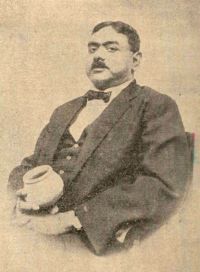
Rakhaldas Bandyopadhyay

Rakhaldas Bandyopadhyay

Summary

Portrait of Rakhaldas Bandyopadhyay Rakhaldas Bandyopadhyay,  The Origin of the Bengali Script (1919)

“ In the Gupta period, the addition of a new variety of the alphabet is now possible, owing to the discoveries of the remains of ancient Indian civilisation in the deserts of Central Asia. Fresh discoveries have also made it possible to trace the gradual displacement of the Eastern variety of the Northern alphabet by the Western one, in the 5th and 6th centuries A. D., and to determine the exact epoch of the final displacement. Finally, new materials have facilitated the determination of the type specimens of each variety, in each particular century, with a nearer approach to accuracy. ”
Source: Wikisource

Portrait of Rakhaldas Bandyopadhyay Rakhaldas Bandyopadhyay,  The Origin of the Bengali Script (1919)

“ The Western and Afghanistan varieties were developed from the old Western variety, while the Central and Eastern varieties were evolved out of the old Eastern. The Eastern variety lost ground and its Western boundary gradually receded eastwards. The development, of the Eastern alphabet only, has been followed in these pages. It has become possible to show, that proto-Bengali forms were evolved in the North-East, long before the invasion of Northern India, by the Nāgarī alphabet of the South-West, and that Nāgarī has had very little influence upon the development of the Bengali script. ”
Source: Wikisource

Portrait of Rakhaldas Bandyopadhyay Rakhaldas Bandyopadhyay,  The Origin of the Bengali Script (1919)

“ The upper part of the left limb of a has become a slightly elongated nail-head or wedge, while the lower part is converted into a regular curve, with a knob at its top, looking more like a comma. The right limb together with the line joining both the limbs, can be drawn at one stroke of the pen and the letter resembles the Bengali one, in its present form. ”
Source: Wikisource

Get perspective with Kwize: daily news enlightened by great literature