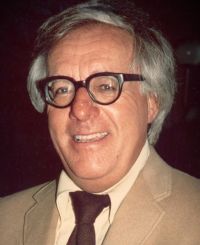
Ray Bradbury

Ray Bradbury

Summary

Portrait of Ray Bradbury Ray Bradbury The shape of things (1947)

If we could see ourselves, no. But, remember, the baby knows nothing of men or women. To the baby whatever shape we're in, we are natural. It's accustomed to seeing us shaped like cubes or squares or pyramids, as it sees us from its separate dimension. The baby's had no other experience, no other norm with which to compare what it sees. We are its norm. On the other hand, the baby seems weird to us because we compare it to our accustomed shapes and sizes.
Source: Gutenberg

Portrait of Ray Bradbury Ray Bradbury The shape of things (1947)

And won't you, doctor, look like some geometrical form instead of a human?"
"Does a blind man who sees for the first time give up his ability to hear or taste?" asked the doctor.
"No."
"All right, then. Stop thinking in terms of subtraction. Think in terms of addition. You're gaining something. You lose nothing. You know what a human looks like, which is an advantage Py doesn't have, looking out from his dimension. When you arrive 'over there' you can see Dr. Wolcott as both things, a geometrical abstract or a human, as you choose. It will probably make quite a philosopher out of you.
Source: Gutenberg

Portrait of Ray Bradbury Ray Bradbury The shape of things (1947)

The pyramidal shape was gone. Polly was crying with happiness.
Peter Horn walked across the room, trembling, trying to smile himself, to hold on to Polly and the boy baby, both at the same time, and cry with them.
"Well!" said Wolcott, standing back. He did not move for a long while. He only watched the White Oblong and the White slim Rectangle holding the Blue Pyramid on the opposite side of the room. An assistant came in the door.
"Shh," said Wolcott, hand to his lips. "They'll want to be alone awhile. Come along." He took the assistant by the arm and tiptoed across the room.
Source: Gutenberg

Get perspective with Kwize: daily news enlightened by great literature