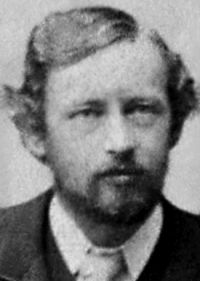
Charles Howard Hinton

Charles Howard Hinton

Summary

Portrait of Charles Howard Hinton Charles Howard Hinton What is the Fourth Dimension? (1884)

We should have no indication of the permanence of its existence. Were such a thought adopted, we should have to imagine some stupendous whole, wherein all that has ever come into being or will come co-exists, which passing slowly on, leaves in this flickering consciousness of ours, limited to a narrow space and a single moment, a tumultuous record of changes and vicissitudes that are but to us. Change and movement seem as if they were all that existed.
Source: Wikisource

Portrait of Charles Howard Hinton Charles Howard Hinton What is the Fourth Dimension? (1884)

And in the first place, a being in four dimensions would have to us exactly the appearance of a being in space. A being in a plane would only know solid objects as two-dimensional figures—the shapes namely in which they intersected his plane. So if there were four-dimensional objects, we should only know them as solids—the solids, namely, in which they intersect our space. Why, then, should not the four-dimensional beings be ourselves, and our successive states the passing of them through the three-dimensional space to which our consciousness is confined?
Source: Wikisource

Portrait of Charles Howard Hinton Charles Howard Hinton What is the Fourth Dimension? (1884)

In discussing the geometrical properties of straight lines and planes, we suppose them to be respectively of one and two dimensions, and by so doing deny them any real existence. A plane and a line are mere abstractions. Every portion of matter is of three dimensions. If we consider beings on a plane not as mere idealities, we must suppose them to be of some thickness. If their experience is to be limited to a plane this thickness must be very small compared to their other dimensions.
Source: Wikisource

Get perspective with Kwize: daily news enlightened by great literature