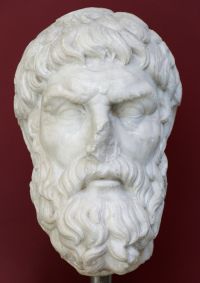
Epicurus

Epicurus

Summary

Portrait of Epicurus Epicurus Letter to Herodotus (1925)

Further, the whole of being consists of bodies and space. For the existence of bodies is everywhere attested by sense itself, and it is upon sensation that reason must rely when it attempts to infer the unknown from the known. And if there were no space (which we call also void and place and intangible nature) , bodies would have nothing in which to be and through which to move, as they are plainly seen to move. Beyond bodies and space there is nothing which by mental apprehension or on its analogy we can conceive to exist.
Source: Wikisource

Portrait of Epicurus Epicurus Letter to Herodotus (1925)

When, therefore, we investigate the causes of celestial and atmospheric phenomena, as of all that is unknown, we must take into account the variety of ways in which analogous occurrences happen within our experience; while as for those who do not recognize the difference between what is or comes about from a single cause and that which may be the effect of any one of several causes, overlooking the fact that the objects are only seen at a distance, and are moreover ignorant of the conditions that render, or do not render, peace of mind impossible—all such persons we must treat with contempt.
Source: Wikisource

Portrait of Epicurus Epicurus Letter to Herodotus (1925)

Nay more: we are bound to believe that in the sky revolutions, solstices, eclipses, risings and settings, and the like, take place without the ministration or command, either now or in the future, of any being who it the same time enjoys perfect bliss along with immortality. For troubles and anxieties and feelings of anger and partiality do not accord with bliss, but always imply weakness and fear and dependence upon one's neighbors. Nor, again, must we hold that things which are no more than globular masses of fire, being at the same time endowed with bliss, assume these motions at will.
Source: Wikisource

Get perspective with Kwize: daily news enlightened by great literature