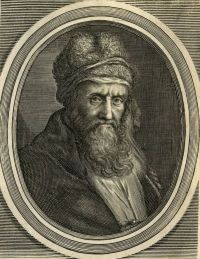
Diogenes Laërtius

Diogenes Laërtius

Summary

Portrait of Diogenes Laërtius Diogenes Laërtius Lives of the Eminent Philosophers… (1925)

For the end of all our actions is to be free from pain and fear, and, when once we have attained all this, the tempest of the soul is laid; seeing that the living creature has no need to go in search of something that is lacking, nor to look for anything else by which the good of the soul and of the body will be fulfilled. When we are pained because of the absence of pleasure, then, and then only, do we feel the need of pleasure. Wherefore we call pleasure the alpha and omega of a blessed life. Pleasure is our first and kindred good.
Source: Wikisource

Portrait of Diogenes Laërtius Diogenes Laërtius Lives of the Eminent Philosophers… (1925)

Who, then, is superior in thy judgement to such a man? He holds a holy belief concerning the gods, and is altogether free from the fear of death. He has diligently considered the end fixed by nature, and understands how easily the limit of good things can be reached and attained, and how either the duration or the intensity of evils is but slight. Destiny, which some introduce as sovereign over all things, he laughs to scorn, affirming rather that some things happen of necessity, others by chance, others through our own agency.
Source: Wikisource

Portrait of Diogenes Laërtius Diogenes Laërtius Lives of the Eminent Philosophers… (1925)

For life has no terrors for him who has thoroughly apprehended that there are no terrors for him in ceasing to live. Foolish, therefore, is the man who says that he fears death, not because it will pain when it comes, but because it pains in the prospect. Whatsoever causes no annoyance when it is present, causes only a groundless pain in the expectation. Death, therefore, the most awful of evils, is nothing to us, seeing that, when we are, death is not come, and, when death is come, we are not.
Source: Wikisource

Get perspective with Kwize: daily news enlightened by great literature