Summary

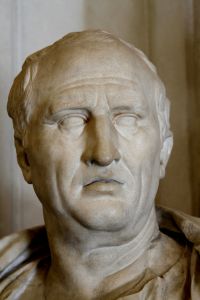
Portrait of Marcus Tullius Cicero Marcus Tullius Cicero The Academic Questions, Treatise De Finibus… (1891)

What do brave men do? Do they enter into an exact calculation of pleasure, and so enter the battle, and shed their blood for their country? or are they excited rather by a certain ardour and impetuosity of courage? Do you think, O Torquatus, that that imperious ancestor of yours, if he could hear what we are now saying, would rather listen to your sentiments concerning him, or to mine, when I said that he had done nothing for his own sake, but everything for that of the republic; and you, on the contrary, affirm that he did nothing except with a view to his own advantage?
Source: Wikisource

Portrait of Marcus Tullius Cicero Marcus Tullius Cicero The Academic Questions, Treatise De Finibus… (1891)

But why need we seek for more instances to prove what is so evident? For let us examine our own selves, and inquire how the motions of the stars, and the contemplation of the heavenly bodies, and the knowledge of all those things which are hidden from us by the obscurity of nature, affect us; and why history, which we are accustomed to trace back as far as possible, delights us; in the investigation of which we go over again all that has been omitted, and follow up all that we have begun. Nor, indeed, am I ignorant that there is a use, and not merely pleasure, in history.
Source: Wikisource

Portrait of Marcus Tullius Cicero Marcus Tullius Cicero The Academic Questions, Treatise De Finibus… (1891)

Clear sight is a good; blindness is an evil. But, though a man may be able to alleviate any single one of these evils by consolation, how will he be able to endure them all? For, suppose one person were blind, feeble, afflicted with grievous sickness, banished, childless, in indigence, and put to the torture; what will you call him, Zeno? Happy, says he. Will you call him most perfectly happy? To be sure I will, says he, when I have taught him that happiness does not admit of degrees any more than virtue, the mere possession of which makes him happy.
Source: Wikisource

Get perspective with Kwize: daily news enlightened by great literature