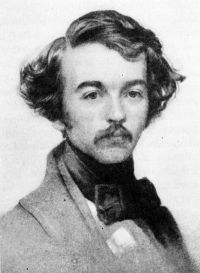
Richard Henry Stoddard

Richard Henry Stoddard

Summary

Portrait of Richard Henry Stoddard Richard Henry Stoddard 1911 Encyclopædia Britannica, Volume 13… (1911)

The writings of Hawthorne are marked by subtle imagination, curious power of analysis and exquisite purity of diction. He studied exceptional developments of character, and was fond of exploring secret crypts of emotion. His shorter stories are remarkable for originality and suggestiveness, and his larger ones are as absolute creations as Hamlet or Undine. Lacking the accomplishment of verse, he was in the highest sense a poet. His work is pervaded by a manly personality, and by an almost feminine delicacy and gentleness.
Source: Wikisource

Portrait of Richard Henry Stoddard Richard Henry Stoddard 1911 Encyclopædia Britannica, Volume 13… (1911)

After a year’s residence at Raymond, Nathaniel returned to Salem in order to prepare for college. He amused himself by publishing a manuscript periodical, which he called the Spectator, and which displayed considerable vivacity and talent. He speculated upon the profession that he would follow, with a sort of prophetic insight into his future. “I do not want to be a doctor and live by men’s diseases,” he wrote to his mother, “nor a minister to live by their sins, nor a lawyer and live by their quarrels.
Source: Wikisource

Portrait of Richard Henry Stoddard Richard Henry Stoddard 1911 Encyclopædia Britannica, Volume 13… (1911)

Brook Farm, as it was called, was a social Utopia, composed of a number of advanced thinkers, whose object was so to distribute manual labour as to give its members time for intellectual culture. The scheme worked admirably—on paper; but it was suited neither to the temperament nor the taste of Hawthorne, and after trying it patiently for nearly a year he returned to the everyday life of mankind.
Source: Wikisource

Get perspective with Kwize: daily news enlightened by great literature