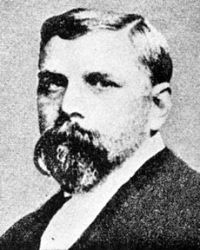
Robert Barr

Robert Barr

Summary

Portrait of Robert Barr Robert Barr The Mill on the Kop (1900)

Now the sharp-eyed Boers in the mill saw a commotion on the distant hilltop. A flag had been planted on the crest. The enemy had charged the kopje and had found there nothing but a shell-swept ridge. The Boers fired volley after volley. Two of their number had gone along the uplands, keeping well out of sight, and, a quarter of a mile away, were exploding loose charges of black powder on the rocks, raising clouds of smoke, deluding the enemy into the idea that from this point were coming the bullets that poured from the mill.
Source: Wikisource

Portrait of Robert Barr Robert Barr The Mill on the Kop (1900)

Life is full of compensations, but the boy did not know this, so the fact brought no consolation to him. Nevertheless he was to have a practical illustration, and in a short time all his disappointment was forgotten. From the top of a distant kopje rose a column of white smoke, and presently across the intervening landscape came the subdued thunder of a cannon. Even the old German became alert, and rose to his feet. More than a quarter of a century had passed since he had seen cannon smoke, and the sound of the gun roused an echo in his heart that had long been asleep.
Source: Wikisource

Portrait of Robert Barr Robert Barr The Mill on the Kop (1900)

The old man gathered the embers of the outside fire and warmed the coffee that the Boers had left. Drinking some of this, the two went into the mill, the boy to clean the rifles and the father to smoke on the balcony that circled the tower, some ten feet from the ground. Here, leaning his arms on the rail, he enjoyed his long pipe and the view. The sun was now descending, and a company of men broke out from cover. The mill was outflanked, and its assailants were brought to a stand by seeing the flag of truce waving above it, the new breeze giving life to the white insignia.
Source: Wikisource

Get perspective with Kwize: daily news enlightened by great literature