Summary

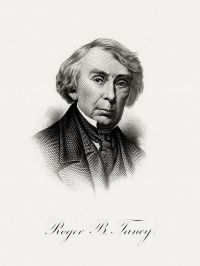
Portrait of Roger B. Taney Roger B. Taney Kelsey v. Fitzhug — Opinion of the Court

No pains were taken to ascertain the course of the Cuba; there was no one upon the look-out the helmsman, and that duty negligently performed by him; and in a starlight night, with four or five miles of deep water on the one side and the open lake on the other, with a light breeze and smooth surface, she run into and sunk a vessel that had been seen half an hour before, at a distance of four or five miles, and which was sailing at the rate of not more than two or three miles an hour, and doing everything in her power to warn those on board the steamboat of her position and her danger.
Source: Wikisource

Portrait of Roger B. Taney Roger B. Taney Kelsey v. Fitzhug — Opinion of the Court

Nor can the jurisdiction of the courts of the United States be made to depend on regulations of commerce. They are entirely distinct things, having no necessary connection with one another, and are conferred in the Constitution by separate and distinct grants. The extent of the judicial power is carefully defined and limited, and Congress cannot enlarge it to suit even the wants of commerce, nor for the more convenient execution of its commercial regulations.
Source: Wikisource

Portrait of Roger B. Taney Roger B. Taney Kelsey v. Fitzhug — Opinion of the Court

The distinction would be purely artificial and arbitrary as well as unjust, and would make the Constitution of the United States subject one part of a public river to the jurisdiction of a court of the United States, and deny it to another part equally public and but a few yards distant.
It is evident that a definition that would at this day limit public rivers in this country to tide-water rivers is utterly inadmissible. We have thousands of miles of public navigable water, including lakes and rivers in which there is no tide.
Source: Wikisource

Get perspective with Kwize: daily news enlightened by great literature