Summary

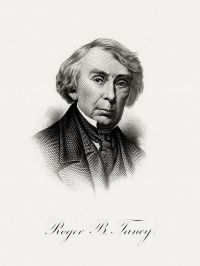
Portrait of Roger B. Taney Roger B. Taney Searight v. Stokes — Opinion of the Court

This, on the contrary, is a contract between two governments deeply concerned in the welfare of each other; whose dearest interests and happiness are closely and inseparably bound up together, and where an injury to one cannot fail to be felt by the other. Pennsylvania, most undoubtedly, was anxious to give to the general government every aid and facility in its power, consistent with justice to its own citizens, and the government of the United States was actuated by a like spirit.
Source: Wikisource

Portrait of Roger B. Taney Roger B. Taney Searight v. Stokes — Opinion of the Court

Under the present law, half toll is charged upon the coaches which carry the mail and passengers; if there is nothing but the mail they go free. Suppose we admit, that the mail is the property of the United States, can a coach be said to be 'laden with the property of the United States' when it has nine passengers in it and only a small mail bag? Or, could this be affirmed of a wagon laden with flour and one musket? Such a construction forces words from their true import. But the mail cannot be properly called the property of the United States.
Source: Wikisource

Portrait of Roger B. Taney Roger B. Taney Searight v. Stokes — Opinion of the Court

It passes through Maryland, Pennsylvania, Virginia, and Ohio, and was constructed at an immense expense by the United States, under the authority of different and successive acts of Congress: the states contributing nothing either to the making of the road or to the purchase of land over which it passes. They did nothing more than enact laws authorizing the United States to construct the road within their respective limits, and to obtain the land necessary for that purpose from the individual proprietors upon the payment of its value.
Source: Wikisource

Get perspective with Kwize: daily news enlightened by great literature