Summary

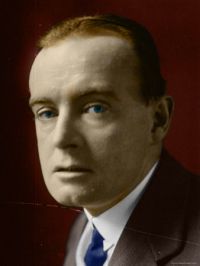
Portrait of Saki Saki When William Came — Chapter XIX (1913)

Some satirical wit started whistling an imitation of an advancing fife and drum band; others took it up and the air resounded with the shrill music of a phantom army on the march. The mock throbbing of drum and squealing of fife rose and fell above the packed masses of spectators, but no answering echo came from beyond the distant trees. Like mushrooms in the night a muster of uniformed police and plain clothes detectives sprang into evidence on all sides; whatever happened there must be no disloyal demonstration.
Source: Wikisource

Portrait of Saki Saki When William Came — Chapter XIX (1913)

Slowly, grandly, with thunder of music and beat of hoofs, the procession passed through the crowd, across the sward towards the saluting base, slowly the eagle standard, charged with the leopards, lion and harp of the conquered kingdoms, rose mast-high on the flag-staff and fluttered in the breeze, slowly and with military precision the troops and suite took up their position round the central figure of the great pageant. Trumpets and kettledrums suddenly ceased their music, and in a moment there rose in their stead an eager buzz of comment from the nearest spectators.
Source: Wikisource

Portrait of Saki Saki When William Came — Chapter XIX (1913)

On the buzz and chatter of the spectators fell suddenly three sound strokes, distant, measured, sinister; the clang of a clock striking three.
“Three o’clock and not a boy scout within sight or hearing!” exclaimed the loud ringing voice of Joan Mardle; “one can usually hear their drums and trumpets a couple of miles away.”
“There is the traffic to get through,” said Sir Leonard Pitherby in an equally high-pitched voice; “and of course,” he added vaguely, “it takes some time to get the various units together.
Source: Wikisource

Get perspective with Kwize: daily news enlightened by great literature