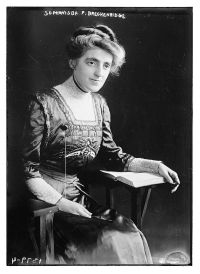
Sophonisba Preston Breckinridge

Sophonisba Preston Breckinridge

Summary

Portrait of Sophonisba Preston Breckinridge Sophonisba Preston Breckinridge New Homes for Old

There are, to be sure, certain inherent difficulties to be met in the instruction of housewives. The old saying, "Man's work is from sun to sun, but woman's work is never done," has been so long accepted as the expression of the inevitable that it is difficult to persuade anyone, most of all the housewife herself, that she can manage to [234] give an hour or two a day to learning something new. Her time seems never her own, with tasks morning, afternoon, and night.
Source: Gutenberg

Portrait of Sophonisba Preston Breckinridge Sophonisba Preston Breckinridge New Homes for Old

It is manifestly impossible for the mother to watch her daughter at work. In the old country this was possible as long as she stayed on the farm. And when at school and at work she is constantly thrown with men, it is impossible to regulate her social hours by the old standards and to see that they are all spent under her mother's eye. Moreover, any attempt to do so is likely to provoke resentment, as a girl naturally thinks that if she can take care of herself at work she is equally well able to do so at play.
Source: Gutenberg

Portrait of Sophonisba Preston Breckinridge Sophonisba Preston Breckinridge New Homes for Old

Special care in applying this principle of all good case work needs to be exercised in the case of the foreign-born family. Moving from one continent to another, with almost every element in the situation changed, makes the adjustment of the family to normal and healthy standards a delicate and important one. We have been told, for example, by thoughtful members of the Italian group, that in their judgment their fellow-countrymen are often led, through unwise alms-giving, not only to pretend to be poorer than they are, but to live in conditions of squalor detrimental to their well-being.
Source: Gutenberg

Get perspective with Kwize: daily news enlightened by great literature