Summary

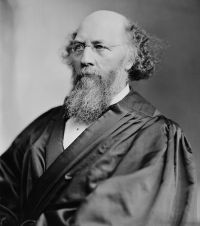
Portrait of Stephen Johnson Field Stephen Johnson Field Pennock v. Commissioners — Opinion of the Court

A treaty of the United States with one of the tribes stipulated that their lands should not be liable to 'levy, sale, execution, or forfeiture,'-terms which wwere held to prevent a levy and sale by officers of the State for taxes, as well as a levy and sale under judicial proceedings. And the act admitting Kansas into the Union as a State provided that the rights of the Indians in the Territory should remain unimpaired, and the general government be at liberty to make any regulation respecting them and their lands which it would have been competent to make had Kansas not been thus admitted.
Source: Wikisource

Portrait of Stephen Johnson Field Stephen Johnson Field Pennock v. Commissioners — Opinion of the Court

To each of them three hundred and twenty acres were to be assigned from that portion of the land relinquished by the treaty to the United States in trust, provided the parties desired to take such tracts. The land thus granted were to remain inalienable except to the United States or members of the tribes, and the grantees were not to participate in the proceeds of the land sold. This article operates as a limitation upon the provisions of the previous articles, and confines them to members of the tribes other than the mixed or half bloods, or the females intermarried with white men.
Source: Wikisource

Portrait of Stephen Johnson Field Stephen Johnson Field Pennock v. Commissioners — Opinion of the Court

Without such designation, inability to alienate the property would be inconsistent with the perfect title which accompanies the patent.
There is nothing in the case of The Kansas Indians, reported in 5th Wallace, in conflict with these views. There the Indians resided in tribes, though their tribal organizations had been much broken in upon by their intercourse with the whites. Patents to individual members, enabling them to hold lands in severalty, were accompanied with a condition against alienation without the consent of the Secretary of the Interior.
Source: Wikisource

Get perspective with Kwize: daily news enlightened by great literature